Octatron sells foldable, backpackable unmanned reconaissance aircraft, throwable cameras, and quick set-up mesh nets.
The drone is 20-30K, lot's cheaper than a helicopter. I predict consumer-range prices (say a tenth of that) in a few years.
I see the LAPD is already using the drones. Fortunately people in LA are used to constant helicopter flyovers so I guess this won't be that big a change.
Yes I feel like I'm living in a Bruce Sterling story.
Showing posts with label guess. Show all posts
Showing posts with label guess. Show all posts
Wednesday, August 23, 2006

Saturday, November 26, 2005
Google vs. print
One of last night's dinner guests runs a small publishing company, so I took the opportunity to ask what she thought of the Google Print controversy. She was unambiguously on the anti-Google side, but I didn't think much of her reasons, which amounted to:
Publishers are not mere middlemen, they can add a lot of value by finding, nurturing, and promoting authors. A lot of the infrastructure of the counterculture is associated with threatened old-media microinstitutions like independent bookstores and small publishers and magazines. These marginal economic activities provide a living to a multitude of authors and middlemen. If all this is replaced with a structure that consists of unpaid content creators (bloggers) and huge technocorporate behemoths (Google, telecoms) that is not necessarily an improvement. Content may be more diverse, but all the money flows to the big entities rather than the creators.
This last point, which is not really an argument, is probably at the root of it. Publishers are scared, and rightlly so, of Google and the entire Internet, which is a threat to their business model. Publishers are middlemen and the net generally serves to drive them out of business with much cheaper and often nbetter alternatives (like Craigslist is doing to newspaper classifieds). I happen to work for a company that is owned by one of the largest publishers in the world, and they are scared, so I guess it's reasonable for a one-person company that is run out of a living room to be scared too.
- It's a copyright violation to scan the whole book (arguably true, but the argument applies equally to scanning web pages, so if this were to hold it would put search engines out of business, not good for anybody).
- Serving up excerpts is not fair use (seems false to me though I suppose there's some legal case to be made)
- Once they serve up excerpts they will then go ahead to serve up entire copyrighted works without paying the copyright holders (certainly a false argument; they could obviously be sued if they started doing that).
- It's rude of them to mess with copyrighted works without asking permission first (not a legal argument, but true as far as it goes. Google seems to be pissing people off unnecessarily).
- Google is a huge behemoth with a $400 stock price, whereas small-press publishers is a tiny, marginal, we-do-it-for-love operation, and they are afraid of getting crushed under the wheels.
Publishers are not mere middlemen, they can add a lot of value by finding, nurturing, and promoting authors. A lot of the infrastructure of the counterculture is associated with threatened old-media microinstitutions like independent bookstores and small publishers and magazines. These marginal economic activities provide a living to a multitude of authors and middlemen. If all this is replaced with a structure that consists of unpaid content creators (bloggers) and huge technocorporate behemoths (Google, telecoms) that is not necessarily an improvement. Content may be more diverse, but all the money flows to the big entities rather than the creators.
Saturday, October 08, 2005
Kommie Kitsch
I took a trip to Budapest a few months back. A beautiful and vibrant city, full of intricate architecture and good food, still in the process of shaking off its long history of being caught in between empires and winding up on the losing side of wars. There are many serious memorials to the failed uprising of 1951. That's one way to get past dictatorship. Another is to take all the kitschy public sculpture erected by the communist regime, and put it in a park out in the suburbs and turn it into a tourist attraction.
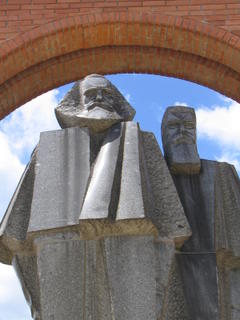
Marx and Engels look blockily down on the world they helped make.

Marx and Engels look blockily down on the world they helped make.

He's got the whole world in his rusting, metallic, inhuman hands.

The locals call this one "Cabana boy rushing to rescue a bather who lost his suit", but it's real name is "The Republic of Councils Monument", and it's huge!
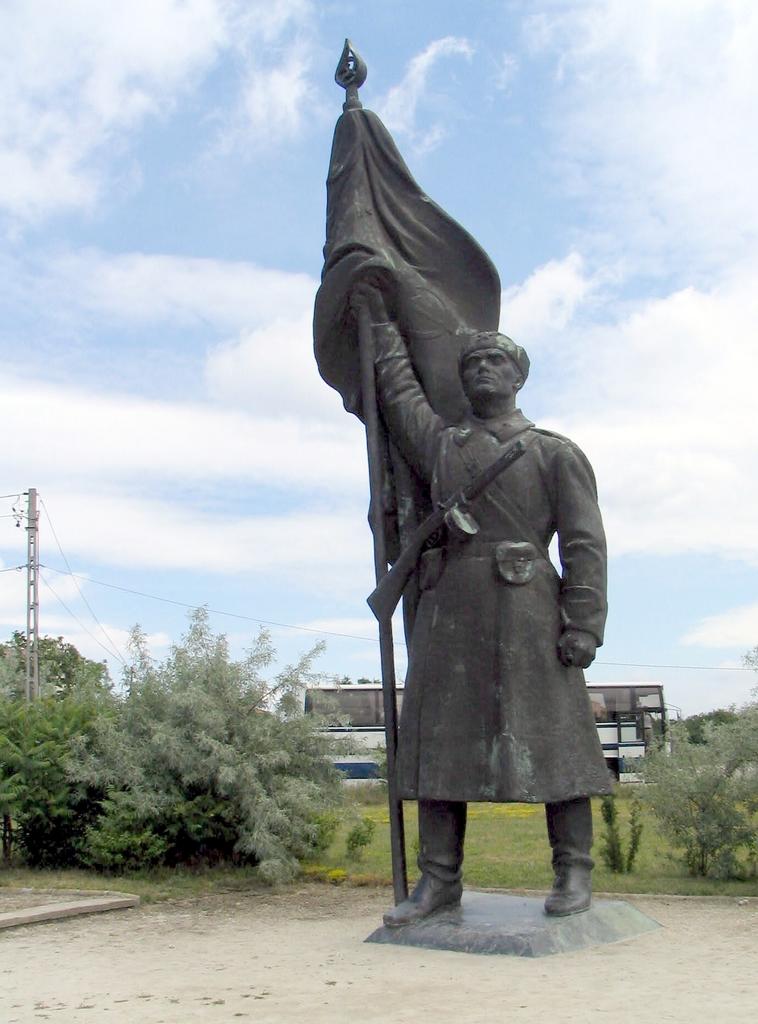
The real face of the occupation.

After the quick visit to Sculpture Park, I managed to squeeze in another side-trip to Gödöllö, a three-umlaut town with a restored Baroque castle, a summer retreat for the Emperor Franz Joseph and the royal family. The hugeness and luxury of such places is supposed to fill one with awe at the power and sumptiousness of the art, but for me they mostly inspire rage at the wastefulness and inequality that had to go into the creation of such a lifestyle for the few. In other words, it gave me a bit of sympathy for the commies, despite their bad taste and their own forms of oppression and murder. It put it in context, at least.
In between these two trips I had to hurry to catch the train out, so succumbed to McDonald's, which I guess represents the end of history, no more class warefare, nobody suffers but the cows, the environment, and health.
Update: more here. The pictures of East European stamps whisked me back to my childhood philatelist days, when I was puzzling over all those blocky hammer designs and why they seemed to be associated with "democratic republics".
Subscribe to:
Posts (Atom)