Continued elsewhere

I've decided to abandon this blog in favor of a newer, more experimental hypertext form of writing. Come over and see the new place.
Showing posts with label ignorance. Show all posts

Sunday, June 03, 2012

Great and Universal Ignorance

The Internet is full of experts, people busily self-branding themself as the go-to person for whatever is the current marketable bit of technology or business or academic fashion. Personally, I've never had much interest in passing myself off as an expert, I'm more fascinated by the huge and ever-growing ensemble of things that I don't know than what I actually do know. To get Rumsfeldian about it, there are the known unknowns – the things I know I don't know (but would like to, if time were infinite), and even at my advanced age there are unknown unknowns, knowable things I am not even aware exist.

Anyway, this passage from a curious little cult book I read in my youth has always stuck with me (emphasis added):
Discoveries of any great moment in mathematics and other disciplines, once they are discovered, are seen to be extremely simple and obvious, and make everybody, including their discoverer, appear foolish for not having discovered them before. It is all too often forgotten that the ancient symbol for the prenascence of the world is a fool, and that foolishness, being a divine state, is not a condition to be either proud or ashamed of.

Unfortunately, we find systems of education today which have departed so far from the plain truth, that they now teach us to be proud of what we know and ashamed of ignorance. This is doubly corrupt. It is corrupt not only because pride is in itself a mortal sin, but also because to teach pride in knowledge is to put up an effective barrier against any advance upon what is already known, since it makes one ashamed to look beyond the bonds imposed by one's ignorance.

To any person prepared to enter with respect into the realm of his great and universal ignorance, the secrets of being will eventually unfold, and they will do so in measure according to his freedom from natural and indoctrinated shame in his respect of their revelation.

– G. Spencer-Brown, Laws of Form
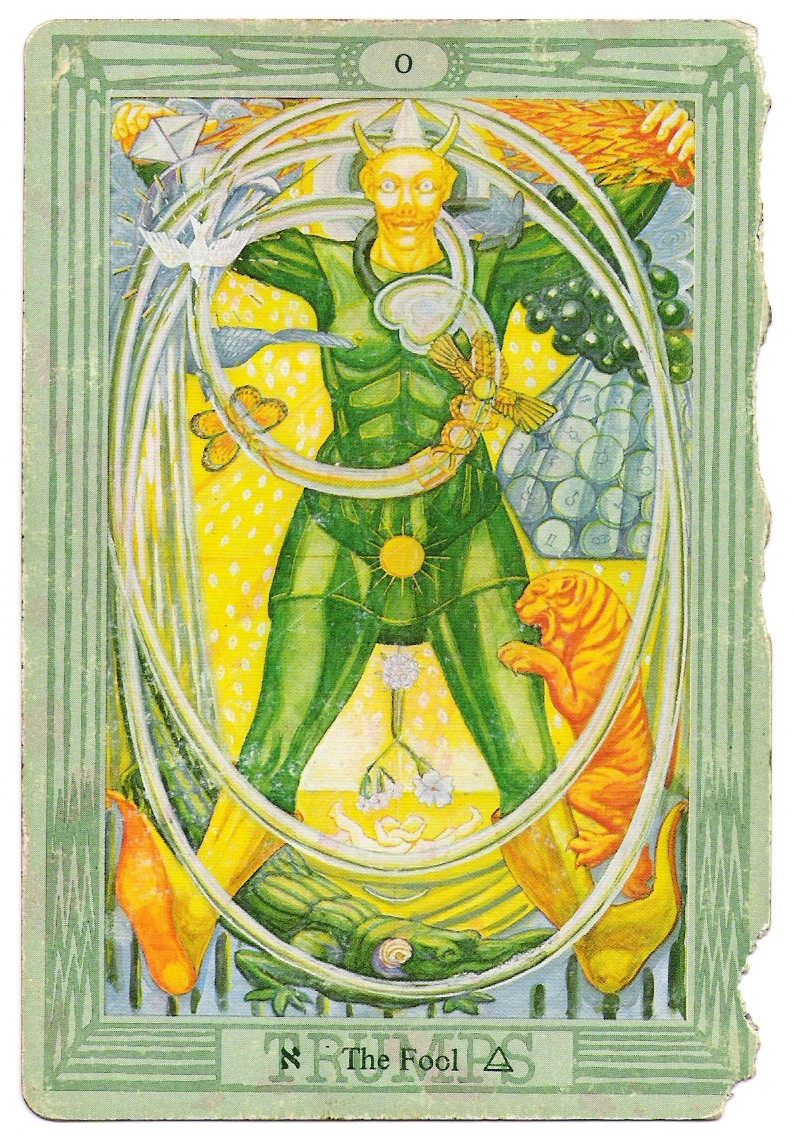
http://magicway.files.wordpress.com/2009/03/thoth-crowly-the-fool.jpg

Saturday, March 29, 2008

Reductionist epiphanies

I sometimes troll the libertarians at Overcoming Bias, but there's a lot of insightful stuff there. A recent post on Fake Reductionism was particularly good, I thought. It dealt with the varying emotional experiences related to reductionist explanations, and it inspired me to write down this long-simmering thought.

Maybe it's peculiar to my own thinking, but I have over the years had a number of experiences which I call "reductionist epiphanies". These are moments when all of a sudden I understand some phenomenon that previously either has mystified me, or that I've simply taken for granted. Generally the answer to the mystery becomes so glaringly obvious that I can't quite remember what it was like to not have that understanding, but enough of my previous state is left around that I can at least recall the fact that I had a thunderbolt of revelation.

The suddenness of these insights seems to be a product of having large chunks of knowledge that were previously separated suddenly come together in a more powerful, unified whole. There's an almost audible feeling of pieces clicking into place.

Anyway, here are three questions which have rather simple and elegant answers. Probably you already know what they are. In case you don't, I'm not going to give it away so you can have the pleasure of revelation when you figure it out.

  • How does a computer translate instructions into action?

  • Why are there three primary colors, when light is a continous spectrum of wavelengths? How does the three-dimensional representation of color used in computer displays map to color as a one-dimensional wavelength?

  • What makes a gene dominant or recessive? 

The answer to the first question is one that anybody with a CS or EE degree learns in the classroom, but because I had a fairly broken and twisted route through higher education I managed to miss this, and instead figured it out on my own -- an entirely more satisfying experience, so I'm grateful for that.