Continued elsewhere

I've decided to abandon this blog in favor of a newer, more experimental hypertext form of writing. Come over and see the new place.
Showing posts with label art. Show all posts

Monday, March 16, 2015

Mr. Burns

I caught a performance of Mr. Burns yesterday, and I would highly recommend it except that I think that was the last of its run in San Francisco. This was a meta enough production to satisfy any nerd — a play about the nature of memory and narrative, whose own story is about survivors of a somewhat unspecific apocalypse trying to keep their lives together by remembering and re-enacting old episodes of The Simpsons.


It occurred to me that Mr. Burns is doing for the future what Art Spiegelman's Maus did for the past. That is, both grapple with issues that are too horrible to contemplate directly by going at them through an ostensibly non-serious medium.


[update Aug 2020: there are now several videos of the play online. This one is a highschool production but looks, if I may say so, "ex-cell-ent". ]

Saturday, October 26, 2013

“God” ≡ God

Three of my intellectual heroes these days, in roughly decreasing order of respectability: Bruno Latour, Christopher Alexander, and Alan Moore. If I squint I can even detect a common project or thread that unites them. For one thing, all seem vaguely disreputable from the standpoint of mainstream thought. In actual fact, all three of these people would likely be pretty welcome in technology circles; and both Latour and Alexander have keynoted major tech conferences. But part of their attraction is a certain outlaw quality that success has not eliminated.

For the other thing: they are all, in different ways, struggling towards the spiritual (for lack of a better term). Latour writes on ecotheology, Alexander is determined to undo materialist metaphysics in favor of something rigorously old-fashioned and hylozoic, and Moore – well, I’ll get to him. This spiritual bent is somehow linked closely to the disreputable qualities. At least in the eyes of the MIT-trained-nerdy-atheist aspect of myself. They beckon to me from outside prison walls that I seem to have erected for myself.

Latour and Alexander I’ve written about previously; Moore is a more recent object of obsession. He is, of course, pretty well-known at this point as the most accomplished writer in the comic book format (Watchmen, V for Vendetta, League of Extraordinary Gentleman). What I didn’t know until recently was that he had declared himself to be a Magician, in roughly the Aleister Crowley sense, and was getting seriously into all sorts of mystical shit. In fact he’s written about this widely and you can find stuff on the net; his series Promethea is pretty much a catalog of various mystical systems in graphical form. While this sort of thing is not really my thing, I can at least respect that it is neither crazy or lamebrained or even supernatural. Here is a rough statement of the core of his stance as I understand it, from an interview in The Believer (emphasis added):
Actually, art and magic are pretty much synonymous. …The central art of enchantment is weaving a web of words around somebody… When that enchantment is the creation of gods and the creation of mythology, or the kind in the practice of magic, what I believe one is essentially doing is creating metafictions. It’s creating fictions that are so complex and so self-referential that for all practical intents and purposes they almost seem to be alive. That would be one of my definitions of what a god might be. …It is a concept that has become so complex, sophisticated, and so self-referential that it appears to be aware of itself….If gods and entities are conceptual creatures, which I believe they are self-evidently, then the concept of a god is a god.
This is more or less exactly the same idea I was groping towards a few years back. Given my background and biases, I’m inclined to think of god-concepts in more quasi-mathematical terms, whereas Moore thinks in quasi-linguistic terms, but I think we are pointing in the same general direction. The title of this post is my attempt to condense the idea down to a sort of formal notation, because that’s what I do.

This way of looking at things seems so simple and obvious and at least partially right that I can’t believe it’s all that original (with either Moore or me). Yet I can’t find much prior art. Perhaps it isn’t really satisfying to most people who want to know one way or the other if there is a referent on the other end of the symbol. Maybe people’s concept of concept is not rich enough to encompass these kind of complex, quasi-autonomous structures. Concepts are insubstantial; gods if they are not mere fiction have some effects in the world. We are used to thinking of symbols as dead things on paper; but the more primal oral form of language was always alive, always closely connected to the real-time human activity of a speaker. The causal powers of words in the old days was immediate and obvious.

But we are getting more experience even in our advanced writing-based culture, with complex symbol systems that are immaterial and yet have effects in the world. That is what software is, after all. Gods are pieces of cultural software, powerful enough to erect cathedrals, start wars, bind together communities. Like software, they are living texts, actualized fictions.

[update:

Another doctrine that might sound profoundly anti-rational is that God’s holy four-letter name, the Tetragrammaton, is identical with God Himself. Unlike other names that merely point to the signified, when the unnamable Absolute becomes known to the created beings by a name, that name itself becomes the personal God of religion, ’Elohey Is ́ra’el. When the Jews received the Torah at Mount Sinai, they experienced a synesthetic vision, in which the sounds of the commandments were seen as flying letters, made of pure light...during their synesthetic experience, the Jews actually saw God as identical to His name. Therefore, it is permitted to bow before the letters of the Tetragrammaton, because they are God, in an esoteric sense, and not just a visual representation of Divinity, which Judaism forbids. 
From Between Enlightenment and Romanticism: Computational Kabbalah of Rabbi Pinchas Elijah Hurwitz, Yoel Matveyev, talking about an 18th century encyclopedia assembled by Hurwitz ]

Tuesday, August 25, 2009

Proteus

Due to a major (positive) life event I have had in the past couple weeks numerous old friends, old photographs, old possessions, and old ideas all turning up unexpectedly. A few weeks back I cleaned out the garage and dug up several boxes of old records, this week I managed to get the turntable hooked up and listened to some tracks that have been following me around unheard of for two decades or more. Old Rounder Records disks (Vassar Clements' Crossing the Catskills, obscure Robert Fripp projects, Roland Kirk Live in Copenhagen 1963, Siegel-Schwall Band. Sweet stuff. Listening to it after all these years felt odd. Most of it I still liked, but not necessarily for the same reasons I liked it back then. I am not the same person I was back then, though he and I obviously have some things in common.

Some weeks before that I stumbled upon the documentary film Proteus which brings together a bunch of my old interests -- form in nature, Coleridge, reconciling science and religion. It is primarily centered around Ernst Haeckel, known mainly today for his exquisitely trippy illustrations of radiolarians and other natural forms, but who was actually one of the major figures of 19th century biology. Large parts of the film are rapid-fire animations based on his drawings. These interests of mine, like the records, have been effectively sitting around in boxes getting slightly musty and mildewed, and it is with mixed feelings that I unpack them and examine them after so many years.

Oddly the film did not touch on the more controversial issues surrounding Haeckel -- his advocacy of eugenics, anti-semitism, and source of Nazi ideology, and accusations that he falsified some of his famous drawings that were a staple of evolution textbooks for decades. The former set of accusations seems exaggerated, since in fact the Nazis banned Haeckel's works along with others advocating "œthe superficial scientific enlightenment of a primitive Darwinism and monism", but it's still an unsettled issue among historians.

My attraction to this stuff has an ambiguous quality. I am fascinated by form and by the various holistic, romantic, or platonic currents of thought at the margins of science, but feel like I can't quite grasp it or devote myself to it wholeheartedly as some do (I dabbled in computer graphics and generative art but don't really have the artist's sensibility). Such stuff almost always seems to veer off into an unproductive self-righteousness and navel-gazing, or worse, cultishness. My background is in quite the opposite direction, but I am unsatisfied with it as I am with all belief systems.

Thursday, May 21, 2009

Be Kind to Your Web-footed Friends, For A Duck May Be Somebody's Mother


Since commenters have been impugning my patriotism, I must share this picture of the SF Ballet School Student Showcase production of Stars and Stripes that I saw last night, a piece based on a set of John Philip Sousa marches choreographed by George Balanchine, with 24 ballerinas wearing endearingly ridiculous costumes, creating an effect that crossed a 4th of July parade with the Rockettes. The male dancers were dressed as Union army soldiers, which led me to expect another group to come out dressed in Confederate gray and re-enact the Civil War as a dance-off, but that didn't happen. The use of the Liberty Bell March (better known for the opening music of Monty Python's Flying Circus) also helped lighten the proceedings.

Classical ballet dancers constitute the most international and cosmopolitan subculture you can imagine; having them re-enacting the forms of traditional small-town American patriotism has got to involve a hint of friendly parody.

Tuesday, April 28, 2009

War Music


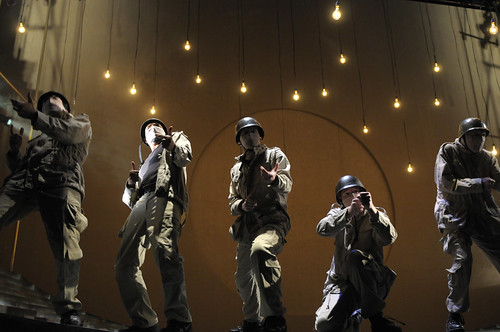
This weekend I went to a preview of the phenomenal new ACT production War Music, a modern reinterpretation of the Illiad based on the translation (or retelling, really) of Christopher Logue. This is a very powerful piece of poetry, with a percussive meter that was used to good effect in the staging.

About a dozen or so actors took on about 40 different parts, and mostly wore identical costumes based on present-day military desert fatigues, with small variations (the Greeks had red berets, the Trojans blue -- the gods wore carnival masks). This made the complex story harder to follow than it had to be.

The gods were played in a comical style which was very effective in conveying their vanity and caprice, although this sometimes went overboard into farce (Poseidon wearing a diver's mask and flippers, for instance).

The set was a minimalist-modern set of risers, with a golden model of the city of Troy set at the back of the stage. I thought that the presence of the sea was indicated very effectively by the use of large billowing cloths. Lighting was also quite effective, especially the use of a multitude of bare bulbs like traced fire that descended during a battle scene. Despite the name, music was not a very prominent element in the show.

This play seems to have gotten rather poor reviews, and I'm not sure why -- perhaps because it isn't structured much like a traditional play. It's really a dramatic reading of a poem, and the poetry is the strongest element of the production. So, here are the opening verses. It seems the only way I can actually manage to slow myself down enough to give poetry a decent reading is by saying it aloud, or by retyping it.

Picture the east Aegean sea by night,
And on a beach aslant its shimmering
Upwards of 50,000 men
Asleep like spoons beside their lethal Fleet.

Now look along that beach, and see
Between the keels hatching its western dunes
A ten-foot-high reed wall faced with black clay
And split by a double-doored gate;
Then through the gate a naked man
Whose beauty's silent power stops your heart
Fast walk, face wet with tears, out past its guard,
And having vanished from their sight
Run with what seems to break the speed of light
Across the dry, then damp, then sand invisible
Beneath inch-high waves that slide
Over each other's luminescent panes;
Then kneel among those panes, beggar his arms, and say:

"Source, hear my voice.
God is your friend. You had me to serve Him.
In turn, He swore: If I, your only child,
Chose to die young, by violence, far from home,
My standing would be first; be best;
The best of bests; here; and in perpetuity.
And so I chose. Nor have I changed. But now--
By which I mean today, this instance, now --
That Shepherd of the Clouds has seen me trashed
Surely as if He sent a hand to shoo
The army into one, and then, before its eyes,
Painted my body with fresh Trojan excrement."

Sometimes
Before the gods appear
Something is marked:
A noise. A note, perhaps. Perhaps
A change of temperature. Or else, as now,
The scent of oceanic lavender,
That even as it drew his mind
Drew from the seal-coloured sea onto the beach
A mist that moved like weed, then stood, then turned
Into his mother, Thetis', mother lovelost face,
Her finger, next, that lift his chin, that push
His long, redcurrant-coloured hair
Back from his face, her voice, her words:

"Why tears, Achilles?
Rest in my arms and answer from your heart."

The sea as quiet as light.

Random connection: Christopher Logue is on record as calling war "a criminal activity", which echoes Charles Tilly's paper War Making and State Making as Organized Crime, found via recommendation by reader bhyde. Me talking about the similarities between governments and organized crime were what got me started arguing with Michael S, back on Mencius Moldbug's blog. It's all connected, somehow.

Friday, December 05, 2008

Art Notes


Psychedelic artist Alex Grey does his part to feed the Obama-as-messiah/antichrist meme.

Also revealed at his website: HR Giger looks even creepier than his art does.

via Sentient Developments.