Continued elsewhere

I've decided to abandon this blog in favor of a newer, more experimental hypertext form of writing. Come over and see the new place.
Showing posts with label religion. Show all posts

Sunday, August 28, 2016

The Pull of the Man

So I՚m not going to Burning Man this year, for various lame reasons. But I feel myself pulled towards it nonetheless, in a weird way that is not exactly wanting in the normal sense. I guess I do want to go again, but I՚m not completely sure why – sure, it՚s a hell of a fun party, but I՚m not that much of a party person. The art is spectactular, but art is not usually capable of motivating me to travel so far from the comforts of home. The political aspect of it – the gifting economy, the sense of collectively building a workable temporary utopia – has a lot of appeal, but it՚s hard to see what it has to do with the power structures of the default world, and politics without real stakes is an unredeemable waste of time. There are a ton of interesting weirdos to meet there, but those connections too don՚t seem to travel back into the default world. I certainly had some worthwhile and unique experiences, but for the most part felt kind of out of it – too old, too asocial, too square, too intellectual, and without access to the right kinds of creative power that would enable me to go beyond spectator status. And it really is not a place for spectators.

Yet still I feel oddly drawn towards it, and I probably can՚t adequately convey the nature of that oddness. After all, it is not so odd to want to go to Burning Man. I assume I am pulled in by forces that are similarly acting on all the 80,000 or so people who are there, as well as those like me who are just dreaming of it. But what is the nature of those forces? They are no doubt various and ill-defined, yet somehow they have sustained the event for 30 years, an incredible length of time for a something like this to persist.

One of my kids asked me the other day about the Grateful Dead concerts I went to in my youth – what did I actually do there? He seemed to be after a deeper answer than “go nuts and have fun” – probably he takes me more seriously than I do myself. And truly, that answer isn՚t satisfactory even to me. I was looking for something larger then that, although I couldn՚t say exactly what. And it՚s not just me, everybody goes to concerts and other happenings or public events because they fill deep and usually unarticulated emotional needs – for meaning, for community, for beauty, for access to the sorts of things that tend to get left out of life under late capitalism.

There is a ritual nature to these events. A ritual, broadly speaking, exists any time humans come together around some shared focus of attention. Every random concert or performance has something of the ritual about it, but Burning Man is more explicit about its ritual structure, from its physical layout to its practices. Black Rock City is arranged in concentric circles, surrounding a mostly empty circle of desert, and directly in the center the Man himself.
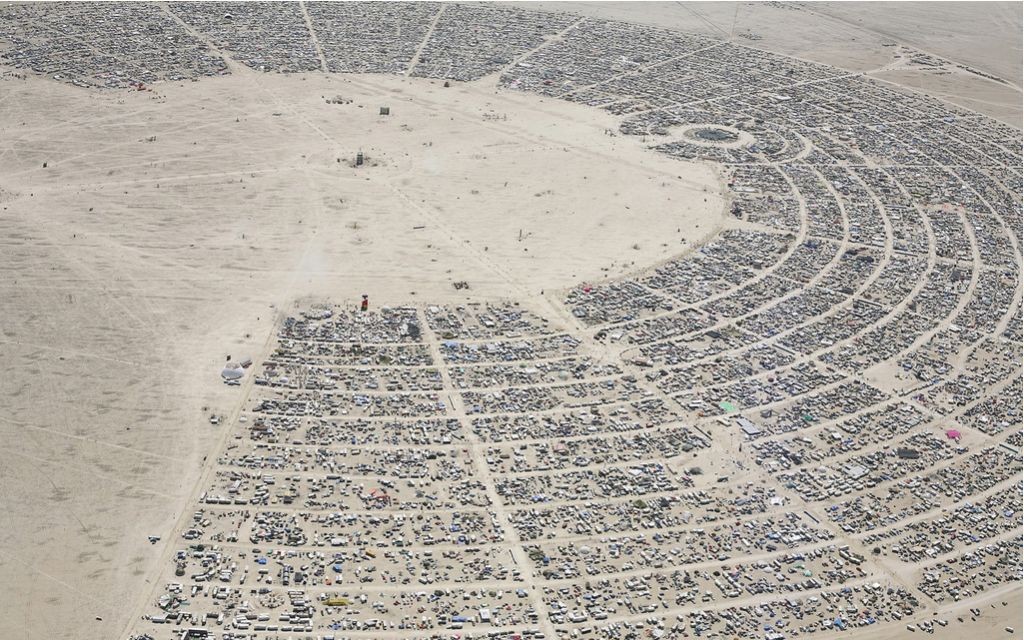

There are some other centers of attraction in the layout, such as a cafe/community center ( a center for talks, small-scale performnances of the hippie arts and the like, and one of the very few places you can spend money). Another is the Temple, which is more for silent contemplation and connection to the higher powers. These two and centers and the main center, the Man himself, are laid out on a central axis.

I have to admit I spent an awful lot of time at the Temple during my one burn – that wouldn՚t have been my conscious choice, there were plenty more fun or interesting places to be than that, but that is where I felt myself pulled. The Man and the Temple are both burned towards the end of the Burning Man week, which determines the temporal side of the large-scale structure of the Burning Man ritual. And, of course, it has the nature of a sacrifice.

Sarah Perry recently published a useful summary of some functionalist approaches to ritual. Such theories are all very well and I՚ve spun them myself, but they are kind of mechanistic and feel external to the phenomenon they are trying to describe. They can explain from an evolutionary standpoint why rituals exist, but they can՚t convey what they are like. Yes, people may perform sacrificial rituals in order to signal commitment and gain status – but that is probably not what they are thinking and feeling while they are doing it. If they are, it isn՚t working – something designed to be directed at lofty communal goals is being perverted into base, greedy, individualistic goals.

And who knows, maybe the vast majority of religious display is infected with this sort of egotistic hypocrisy, but I can՚t believe that it all is. Perhaps I am naive, but it seems to me that people are often quite sincere in their displays of religious enthusiasm – that is, they actually want to participate, they want to be directed at something outside of and higher than their usual concerns, and they are drawn into the ritual based on its nature and their own, not by external compulsions or calculations. Since people are not naturally going to stop engaging in egotistic calculations, part of an effective ritual is that it breaks down individuality. This condition is both terrifying and desirable, and this contradiction underlies some of the weird dynamics of ritual and religion.

It is this desire for transcendence that strikes me as somewhat mysterious, at least in my own case. This mysterious attraction appears to be spiritual in nature. I really hate to use that word, my self-image rejects it. It՚s embarrassing to find myself longing for spiritual experience, to want to be in the sort of place and state of mind in which the individual ego gives way, where the infinite contacts the finite, where the ineffable expresses itself. Such desires don՚t fit in with my self-conception as a realist, pragmatist, materialist, member in good standing of the techno-intelligentsia, and general competent adult.

Maybe It՚s not the spirituality that is embarassing – after all this is California in the 21st century, and everyone is permitted, if not actively encouraged, to engage in all manner of practices. No, it is the longing that is vaguely shameful – at my age, I should just go after what I want, or give it up, all this mooning after the impossible-to-get seems juvenile, especially in the land of do-as-you-please.


But I don՚t think my feelings and reactions are anything out of the ordinary. I may be more conscious of them than normal people, for a variety of reasons, but that doesn՚t make them special. So I conjecture that rituals are structured in such a way as to focus people՚s attention and desire onto something transcendent, that is, something not quite real in the ordinary sense, and thus not really attainable. Longing is built-in to the structure of the sacred.

And if something shameful adheres to the notion of longing, at least a ritual allows people to do it collectively, to align their longings with that of others. Individual longing may be a puerile waste of time; collective longing defines a culture.

[My earlier trip report and an alternative, less weighty view of the nature of the event.]

Monday, May 07, 2012

The Prophet Motive

Our shul is having an an internal debate on how much to align ourselves with the Occupy movement. So we had a teach-in, and for that, I did some research on the Biblical and earlier history of the Jubilee tradition. Turns out damaging concentrations of wealth, and ways deal with the economic problems they cause, have both been around for a long time. The Torah is full of what is basically commercial law, which has always seemed kind of boring next to miracles and war and murder and the like, but when approached with the right mindset can be quite fascinating.

One insight I did not bring to the table: The movie version of Fight Club is centered around a debt-retirement scheme, achieved in that case through violence represented by blowing up the office buildings of credit card companies.

The teach-in was only moderately successful from my perspective. I am not big on face-to-face group meeting/discussions, I vastly prefer to have such things over email or similar medium where you don't have everyone constantly jockeying for get their turn to speak, where digressions don't waste people's time, and points can be followed up at leisure…on the other hand, you can't share food that way, and that is half the point of these things.

[Earlier postings on the subject]

Tuesday, February 07, 2012

Academic units with mildly amusing names, #6 in a series

The Center for Spiritual Capital, Loyola University (New Orleans)

This looks like a rather strained effort to reconcile capitalism and Christianity, rather than what a literal reading of the name would suggest, that spirit itself is something to be accumulated, invested, and profited from. They do not seem to have had much problem coexisting in the real world despite their manifestly clashing values. But as always I strongly support the invention of new and slightly weird realms of discourse. Push that camel through the needle!

I'm also glad to add this moderately right-wing entry to the series; most of the previous ones were from the leftist/new age end of the spectrum. Fair and balanced!

Thursday, September 29, 2011

Random Rosh Hashana Religion Ruminations

Today is Rosh Hashana, went to services last night, as usual am suffering the effects of being half-in and half-out of this religion thing.

Religion is how people and communities establish a relationship to the transcendent, to the eternal, to the infinite, to the absolute, to the sacred, to things unseen and to the powers that underlie the world. So in some sense, you have to have a religion, even if it's one that denies that these things have any sort of reality or meaning whatsoever -- that too establishes a relationship. We all have to live in the world, we all have to deal with its immensity and our smallness.

If the above is how we relate to the cosmos, the other part of religion is about how we deal with each other. It is less clear to me that these things have to be managed by the same institution, but that seems to how things have evolved.

Judaism is very proud of the fact that it invented monotheism (highly disputed, Freud thought they got it from the Egyptians, here's an interesting looking paper that traces it back to Assyria), supposedly the best idea evar. Opinions differ, some say it's the worst. My own feelings (good for today only):

a) it's an important step in the evolution of the human mind, that is, it has approximately nothing to do with whatever is powering and governing the universe and a lot about how we construct and construe ourselves;

b) while it's a crucial part of the growth of western civ, including the devlopment of science, and thus is baked into the deep structure of my own mind, we are in a cultural point where we have to move on to the next thing. God is dead, but gods have a way of coming back from death, generally transformed in some way.

The flavor of Judaism I am currently involved with is the San Francisco fuzzy kind, so the kind of monism on display tends towards the mystical rather than the authoritarian. That's a lot more acceptable, although sometimes it gets too gloppy for me. Everyone's too nice, it leaves out the part of Jewish culture that resonates most with me, argument. On the other hand, insofar as it works for me at all, it works because the genuine spirituality of the community is capable of sneaking past my rationalist defenses.

Monday, August 08, 2011

How to avoid the singularity

I have somewhat unaccountably been asked to be on a conference panel on the topic "Inconsistency Robustness and the Singularity". What do I know about the singularity? It is unknowable by definition. So almost anything said about it is guaranteed to be nonsense.

Yet nattering on about the unknowable is long human tradition. It is increasingly obvious to me that Singulatarianism has the form of a religion, specifically, a religion of the monotheistic, transcendent, and eschatological sort. God is the original singularity, and the technological singularity that is so longed for is just the rapture for nerds.


This is not exactly a criticism -- there's nothing inherently wrong with religion in my view, but there is something wrong in practicing religion while failing to acknowledge it, and instead pretending to "rationalism" (at least when rationalism was young, this was explicit).

Monotheism is the source of much that is good and even more bad in our thinking. Whatever good it may be responsible for (science!) it's pretty clear that it died in the modern era and we are in the midst of its death throes. Singulitarianism is just one of the spasms, a church for shallow thinkers, people who thought they'd gotten rid of a theistic mythology only to replace it with a near-replicate. It is not radical enough, because it presumes that while enormous technical changes will happen, we (the nerds) will still be pretty much the same. Consider eg the obsession with cryonics, which is nothing more or less than the effort to sustain the atomic, isolated indvidual past the point of death.

The cure for singulatarianism lies is in the direction of sociology and network thinking in general. Monotheism wants to collapse the universe's locus of control into a single transcendent point; whereas the reality of human life has it distributed all over the place. The real radical changes will come not from hyper-empowered individuals but from the networks that are in the process of being woven, of which the current most visible (Facebook etc) are just a shadow, a hint. The world runs on networks and will be determined by them. Perhaps a different theology is required.

What's this have to do with inconsistency robustness? Well, the implications for computational systems is that they too need to deal with distributed control, divergence of beliefs, goals, plans. Traditional logic is to monotheism as distributed, inconsistentent, argument-based logics are to a network-based metaphysics. In a distributed world, inconsistency is the norm and consistency the exception. The social world has evolved techniques for producing consistency and cooperation; computation needs to learn to do the same.

Hm, well, I have no idea how much of this I can or should shoehorn into a presentation at a technical conference.

[update: my slides]

Saturday, June 25, 2011

Why do religion?

I feel a need to apologize for or explain the recent excursion into mystical shit. Why, I'm not sure -- who am I apologizing to? Myself I guess. Does anyone else care? In part it was motivated by a feeling that I have to put some money where my mouth is. If I really believe, as I've said here on occasion, that religion is an important and fundamental part of being human, then I have to do it. Whatever religion is, it's not just something you think about or believe, it's something you practice. So I'm doing, in a fairly random and haphazard way, to be sure.

The whole Omer/Kabbalah stuff really just served as way to nucleate my usual self-absorption along certain lines that happened to be the same as other people in our synagogue's little study group. The point of this was to do this collectively, as part of a social group, which is not something I normally do. It's hard to make sense of that communal act out of its context -- it is at least as much about doing something together with a particular group of people as it is about the ostensible content. Last week I was at a scientific meeting on synthetic biology (crashing it actually), and I'm struck by what ought to be by now a banal truth, which is that more than half the point of these things is networking or simply being there and constituting a social group, rather than some kind of pure disembodied information exchange. This is a pervasive phenomenon, but it's just more obvious in the case of religion than it is in cases where there are rational reasons for people to be together.

So religion is fundamentally social, just like everything else. I am someone who is (or at least perceives himself as) fundamentally asocial and areligious, and constantly working on trying to fix that.

What I ask of the free thinker is that he should confront religion in the same mental state as the believer -- He who does not bring to the study of religion a sort of religious sentiment cannot speak about it! He is like a blind man trying to talk about colour.

The most bizarre or barbarous rites and the strangest myths translate some human need and some aspect of life, whether social or individual -- Fundamentally, then, there are no religions that are false. All are true after their own fashion. All fulfill given conditions of human existence, though in different ways.

Because society can exist only in and by means of individual minds, it must enter into us and become organized within us. That force thus becomes an integral art of our being...

There cannot be a rational interpretation of religion which is fundamentally irreligious; an irreligious interpretation of religion would be an interpretation which denied the phenomenon it was trying to explain.

From my standpoint...religion ceases to be an inexplicable hallucination of some sort and gains a foothold in reality. Indeed, we can say that the faithful are not mistaken when they believe in the existence of a moral power to which they are subject and from which they receive what is best in themselves. That power exists, and it is society...In this way, religion acquires a sense and a reasonableness that the most militant rationalist cannot fail to recognize. The main object of religion is not to give man a representation of the natural universe...religion is first and foremost a system of ideas by means of which individuals imagine the society of which they are members and the obscure yet intimate relations they have with it.

-- Emile Durkheim (the son of a rabbi, I just learned), The Elementary Forms of Religious Life

Well, I could pull quotes from Durkheim all day, but the overarching point is that religion is about something real, and that whatever it is, is the same thing that animates social life in general. So, my interest in religion has two aspects: from the personal side, I do it to align myself with the social, something that I feel I need to do in order to be a mature adult (still working on that at my advanced age). And from the outside, I don't think you can understand politics without understanding religion, a point I touch on occasionally and is the subject of an interesting-sounding new book on "political theology".

We live in a dangerous time. The old gods are dead, the new ones have not sorted themselves out yet. I feel some sort of an obligation to be part of the sorting process.

Wednesday, December 22, 2010

"A power so great, it can only be used for Good or Evil"

As I knew would happen, my earlier unfair review of Kevin Kelly's What Technology Wants obligated me to read the thing and give it a real one. I have to say I wanted to pick a fight with this book, for reasons that are unclear to me. Partly it's because it is in some ways very close to my own point of view, yet so different in important respects, and I'm a People's-Front-Of-Judea type of guy. Partly it's that Kelly is selling grand visions, but he seems to be unable or unwilling to also adopt the equally important critical stance. But I was disappointed in my search for an argument, because this turns out to me an essentially religious book, and in my experience there's no point arguing with religion. Either you buy into the vision or you don't. So the subject of this book is not actually technology, but the nature of existence itself and where it is supposed to be going.

You'd think the story of technology would be a large enough subject in its own right, but Kelly's scope is so all-encompassingly vast that he has to devote the a good chunk of the book to a discussion of biological life. This is necessary because a key part of his argument is that life and technology are just different aspects of the same process. Evolution (or whatever you want to call it) may have started with chemistry and nucleic acids but is now working with electronics and silicon. In support of this argument, he compares the evolution of various technological forms with biological evolution (eg, the way variant forms of military helmets or trumpets can be arranged in phylogentic trees), and then elides the differences between them, in order to paint them as just different phases of some grander tendency of the universe to evolve towards complexity/goodness/whatever. Progress, in other words. The technium (Kelly's term for the whole sphere of technological development) is simply an extension of the biosphere, or both are manifestations of some underlying, more abstract tendency.

That's the first part of Kelly's thesis. The second is that the evolution of both life and technology is a strongly convergent process, meaning roughly that while evolution obviously involves large amounts of randomness and contingency, its general tendencies and ultimate destination is in some sense foreordained. It was inevitable that we'd evolve multicellularity, muscles, eyes, and computation, although the exact form may vary across the possible universes. Kelly labels this "ordained becoming" and I believe most of these ideas have their roots in the work of Simon Conway Morris, an evolutionist who (not coincidentally) also has a "theology of evolution" at the core of his thought.

Inventions and discoveries are crystals inherent in the technium, waiting to be manifested. There is nothing magical about these patters, nothing mystical about technology having a direction. All complex, adaptive systems...will exhibit emergent forms and inherent directions. (p 186)
Given the above points, the story becomes not so much "what technology wants" as where technology (and everything else) is inevitably heading. This may be a difference which may make no difference, just as it doesn't matter in some sense whether a sunflower follows the sun because it "wants" to or it has an innate tropism-generating mechanism. Calling the trajectory of technology a "want" suggests, though, that it might want something different, or that it can be induced to go somewhere else. The arguments Kelly advances suggest otherwise.

The third part of the book is devoted to those who think they can escape from technology (such as the Amish) or put a halt to its onslaught (such as the Unabomber). It's a bold choice to make Ted Kaczinsky the focus of a chapter, I thought. Kelly does a credible and fair job of presenting his viewpoint. But the (perhaps unintended) thrust of this is to paint anybody who hopes to argue with or resist the advancement of an autonomous, self-willed technium as a madman. There are many level-headed and sane critics of technology that could have been used as foils. In some ways Kaszinscky is Kelly's mirror-image: both are equally eager to totalize technology, to paint it as a unified and nearly unstoppable force.

The urge for self-preservation, self-extension, and self-growth is the state of any living thing...there comes a moment in the childhood of our biological offspring when their childish selfish nature confronts us, and we have ot acknowledge that they have their own agenda (sic)... Collectively we are at one of these moments with the technium...At a macroscale, the technium is following its inevitable progression. Yet at the microscale, volition rules. Our choice is to align ourselves with this direction, to expand choice and possibilities for everyone and everything, and to play out the details with grace and beauty. Or we can choose (unwisely, I believe) to resist (p187)

It's odd that more reasonable efforts to redirect technology are given short shrift, given that Kelly was an editor of the Whole Earth Catalog, which advanced the idea that you could repurpose and redirect technology for alternative purposes. I guess his later career at Wired has overridden that...but he does run a site called Cool Tools which is very close in spirit to the old WEC, so he hasn't abandoned that ethos (in fairness, Kelly does discuss his personal transition from low to high tech).

The fourth part of the book is an effort to characterize the nature of the inevitable progress of technology. "Technology wants what life wants" which is "increasing efficiency, increasing opportunity, increasing emergence, increasing complexity...increasing freedom, increasing mutualism increasing beauty... " (p 270). This is the point where things skidded off the road and into the gauzy, light-filled realm of heaven for me. I've been a technologist all my life, and while I certainly believe in the wonderful things it can do and the beauty it embody, I can't take such a rosy view. Technology is not just your iPhone and Facebook, it's hydrogen bombs, ecological disaster, and the constant radical undermining of human values. It's not just those either, of course, but to consider one side without the other can't be done if you are trying to get an honest picture of the technosphere. It's the same as with biological life, which for all its beauty has no particular interest in your personal well-being and contains many "wanters" that treat humans as so much raw material, from mountain lions to malaria parasites.

Kelly is not oblivious to the possible downsides of technology, of course. But when it comes time to tot up the good vs the bad, it comes down to this:

The message of the technium is that any choice is way better then no choice. That's why technology tends to tip the scales slightly toward the good, even though it produces so many problems...it compounds the good in the world because in addition to the direct good it brings, the arc of the technium keeps increasing choices, possibilities, freedom, and free will in the world, and that is an even greater good.
Argh, this is libertarian rot. A greater availability of choice is not always "good". Would we be better off if anyone could have the choice of obtaining RPGs or nuclear weapons at the local 7-11? More choices can make people overwhelmed and unhappy. And if we are being propelled irresistibly forward into some foreordained attractor, do we really have any choice at all?

Kelly is constantly revisiting the issue of whether technology makes us better people or not. I find this a ridiculous question, and it undercuts his own premise. We do not have the option of doing without technology, with all due respect to Amish refuseniks. As a civilization, a species, we've built ourselves a technological layer that we now live in and can't get rid of (unless we are prepared for an order-of-magnitude dieoff). The question of "is technology good or evil" is a stupid question, frankly. You can talk about a particular bit of technology and what its effects are and what human interests it serves or subverts, but to try to put a moral valence on technology as a whole is like a fish giving a lecture on "water: threat or savior"?

As before, I can't help but compare Kelly to Latour. Both start with what should be a fairly straightforward task of describing the processes of science and technology, but end up going off on wild metaphysical joyrides. The difference is that Latour has a political/sociological view, while Kelly's is primarily religious (not that Latour doesn't get into that now and then). Both are trying to locate agency somewhere other than in its traditional home of individual humans, but while Latour distributes it throughout the material world, Kelly seems to locate it in some transcendent heavenly omega point. That's why ultimately Latour seems to be more of a humanist -- the desires he talks about are human-scaled, even if they inhabit odd objects.

To summarize: this book is the product of a particular kind of vision, of a world that is hurtling despite itself towards a transcendently positive future of increasing complexity and capability. "Technology" is not the real subject, that just happens to be the current edge of the curve. It's an attractive vision, and certainly it's possible to see some of this in the world when approached from the right angle. Evolution and related processes do have a ratchet effect; the world is learning to do what it does better. That's great, but either this happens with human guidance or without it. If technology in truth can't be managed, then we don't really need to think about it, we can just play with our gadgets. If, on the other hand, technology can be shaped and guided by humans, then we need better ways to do just that. Dealing with climate change is the most obvious area where we need more control, not less. Getting transported into ecstasies by the technical sublime doesn't help. The reality of our technological world -- its glories and its disasters, its potentials and ptifalls -- has to be faced squarely. Trying to paint a moral valence on technology as a whole is a mistake; like the humans who propel it forward, it contains multitudes.


[[title courtesy of The Giant Rat of Sumatra by The Firesign Theater]]

Sunday, September 26, 2010

Under construction

Construction is one of those intriguing ideas that seems to some people (including me, some of the time) to be so strong that it has the potential to remake one's entire worldview. The idea that ideas are constructed appears in various confusingly overlapping schools of thought: constructivism, (Piaget, Vygotysky), constructionism (Papert), and social construction (Latour and assorted philosophers). Here's a paper that untangles some of these differences, but here I'm interested in their common thread -- the idea that knowledge, ideas, mental stuff in general is built rather than found.

Constructivism is usually applied to things like people learning mathematics or object permanence, but the thing that most people spend most of their energy constructing is themselves -- their social roles, their internal sense of self, their own narratives. But then who is doing the building? The term "autopoeisis" was coined by Maturana and Varela to name systems that constructed themselves, but naming is not explaining and as far as I know the school of thought they founded belongs in the same category as some of the other ideas I've mentioned recently -- which is to say, not necessarily wrong, but it has not been nearly as productive of science as more boring mechanistic approaches. It's fringy.


There's a vast literature on self-construction in anthropology, psychology, and related fields most of which I'm unfamiliar with, and I've never been able to quite get into it when I tried. How do you study something so elusive and amorphous? There are no instruments for selves, and studying social interaction (which seems the best entry into the subject) just gives you the traces, not the phenomena itself. But that's a reflection of my intellectual limitations, or rather, how my own self is constructed.

It occurred to me today that one of the main functions of religion is to construct selves. Theistic religions construct a person who runs the universe and provides rules and techniques for the individual person to relate to it. Such relations obviously mirror the relations between actual human persons, and vice-versa. Consider the historical construction of human selfhood, religions function as a kind of cultural scaffolding for individuals to create and interpret themselves.

Religions create persons in very different ways and, so as a result create very different kinds of selves. Someone who believes they are at the core an immortal being who is only temporarily and incidentally wearing a body as a kind of fleshly envelope just has/is a very different kind of self than I do/am. Yet this song still moves me, so maybe the differences are merely superficial and our spiritual core is the same.


Buddhists seem to be deconstructionists of the self -- they talk about this process critically. They talk about how people are constantly trying to make themselves appear to be solid, permanent, real things when in fact they aren't. And this process of delusion is at the root of suffering. But my own dabbling in meditation (Buddhism ultra-lite at this point) suggests the opposite -- it seems to be about constructing an additional layer of self, one that can stand somewhat outside and monitor all the other self-construction going on. I may be doing it wrong.

During the Yom Kippur service, the Ashamnu prayer has the congregation chanting together:
Ashamnu, bagadnu, gazalnu, deebarnu dofee. Heeveenu, v' heershanu, zadnu, chamasnu, tafalnu shaker. Yaatznu ra, keezavnu, latznu, maradnu, neeatznu. Sarar'nu, aveenu, pashanu, tsarar'nu, keesheenu oref. Rashanu, sheechatnu, teeavnu, taeenu, teetanu.

Who are we? We are God's image and truth and infinite wisdom, eternal goodness. Yet we've abused, we've betrayed, we've been cruel, yes we've destroyed...we have missed the mark.
The "infinite wisdom and eternal goodness" seems to be a recent addition to this particular translation, and it's a bit too treacly a sentiment for me. But the idea that sin is an error, a case of "missing the mark", I can get behind. (Here's a good present-day interpretation). The most striking feature of the Hebrew is that it is a litany of words suffixed with -nu, the first person plural possessive ("our"), which emphasizes that all these faults are faults of the community and not solely of individuals. Consider not so much content of this prayer, but the fact that here's a community of people who get together, at some expense of time, money, and attention, and jointly declare a view of their nature. Isn't that odd? It seems almost to be a performative linguistic act, not as explicit as a marriage vow, but still functioning to bind together.

So the self under construction in this world is a social self, a self inherently part of a community doing things together and taking a collective responsible for itself and the world. Maybe this is an unremarkable thing to most people; after all Jews and others have been doing it for thousands of years; if it's so fundamental to human nature then it usually operates without thinking about it. I may be more consciously and intellectually aware of these sorts of commonplace phenomena because with me they don't generally work all that well.

Tuesday, August 31, 2010

Submission

I had an unusual Sunday evening: I got invited/dragged to a Ramadan break-the-fast interfaith service, in a mosque just off of Market street in San Francisco. There were some speeches promoting interfaith understanding and the idea of a moderate version of Islam, a service in the mosque, and a vegetarian dinner (mostly Pakistani food). The first part succeeded in conveying that Muslims were normal people who could even tell jokes. The second part was the first time I had seen Muslim worship up close, and it both moved and disturbed me...the muezzin's call harking back to ancient desert tents, the women relegated to the back of the large east-facing room, the men prostrating themselves.

One of my companions mentioned that, for all the cultural similarities between Jews and Muslims, there were some key differences in their beliefs, which he boiled down to the idea that Jews are supposed to wrestle with god while Muslims are supposed to submit. The idea of submission has a powerful spiritual charge, to be sure, a form of or pathway to egolessness. But it's not really my thing, although I guess there's an element of it in my awkward dalliances with any sort of religious practice.

The prostration was the point at which my empathy dropped away and I felt momentarily that I was viewing something foreign and potentially dangerous. The moment passed, but left me with the realization that interfaith understanding and coexistence is not something easy and automatic, but must be laboriously constructed. And of course there is a whole network of people -- the "interfaith community" -- who do this on a regular basis.

There were quite a few references to the Cordoba House project, of course. I went to this event partly to spit in the eye of the repellent and harmful Islamophobia on display from the likes of Newt Gingrich. But it can't be denied that any religion has the potential to pose a threat to the liberal order of society, and while most Muslims aren't al-Qaeda they don't exactly strike one as fertile grounds for progressive values. So my feeling is, build the community center by all means, and encourage the more progressive elements in Islam and build dialog, but at the same time I can't entirely dismiss the fear that the right is mongering.

Oh well, to get the taste of submission out of my mouth, here's St. Yossarian:
"And don't tell me God works in mysterious ways," Yossarian continued, hurtling on over her objection. "There's nothing so mysterious about it. He's not working at all. He's playing. Or else He's forgotten all about us. That's the kind of God you people talk about-a country bumpkin, a clumsy, bungling, brainless, conceited, uncouth hayseed. Good God, how much reverence can you have for a Supreme Being who finds it necessary to include such phenomena, as phlegm and tooth decay in His divine system of creation ? What in the world was running through that warped, evil, scatological mind of His when He robbed old people of the power to control their bowel movements? Why in the world did He ever create pain?"   
"Pain?" Lieutenant Scheisskopf's wife pounced upon the word victoriously. "Pain is a useful symptom. Pain is a warning to us of bodily dangers."   
"And who created the dangers?" Yossarian demanded. He laughed caustically. "Oh, He was really being charitable to us when He gave us pain. Why couldn't He have used a doorbell instead to notify us, or one of His celestial choirs? Or a system of blue-and-red neon tubes right in the middle of each person's forehead. Any jukebox manufacturer worth his salt could have done that. Why couldn't He?"   
"People would certainly look silly walking around with red neon tubes in the middle of their foreheads."   
"They certainly look beautiful now writhing in agony or stupefied with morphine, don't they ? What a colossal, immortal blunderer! When you consider the opportunity and power He had to really do a job, and then look at the stupid, ugly little mess He made of it instead. His sheer incompetence is almost staggering. It's obvious He never met a payroll. Why, no self-respecting businessman would hire a bungler like Him as even a shipping clerk!"   
Lieutenant Scheisskopf's wife had turned ashen in disbelief and was ogling him with alarm. "You'd better not talk that way about Him, honey," she warned him reprovingly in a low and hostile voice. "He might punish you."   
"Isn't He punishing me enough?" Yossarian snorted resentfully. "You know, we mustn't let Him get away with it. Oh, no, we certainly mustn't let Him get away scot  free for all the sorrow He's caused us. Someday I'm going to make Him pay. I know when. On the Judgment Day. Yes, that's the day I'll be close enough to reach out and grab that little yokel by His neck and-"   
"Stop it I Stop it!" Lieutenant Scheisskopf's wife screamed suddenly, and began beating him ineffectually about the head with both fists. "Stop it!"   
Yossarian ducked behind his arm for protection while she slammed away at him in feminine fury for a few seconds, and then he caught her determinedly by the wrists and forced her gently back down on the bed. "What the hell are you getting so upset about?" he asked her bewilderedly in a tone of contrite amusement. "I thought you didn't believe in God."   
"I don't," she sobbed, bursting violently into tears. "But the God I don't believe in is a good God, a just God, a merciful God. He's not the mean and stupid God you make Him out to be." 
Yossarian laughed and turned her arms loose. ‘Let’s have a little more religious freedom between us,’ he proposed obligingly. ‘You don’t believe in the God you want to, and I won’t believe in the God I want to. Is that a deal?’

-- Joseph Heller, Catch-22
Random related links:

Background on mosques in America

Asshole against coexistence

Islamophobia and Reality

Sunday, August 15, 2010

Singularity Summit interim review

I'm almost disappointed, but the Singularity Summit (so far) has been decidedly less flaky than I anticipated. At least the talks were largely by actual scientists, with only a smallish percentage of random flamage. The crowd is something else again though -- the cultish aspects come through in my casual conversations with people. The speakers barely mention the singularity, confining themselves to actual technoscientific developments, but the audience has been murmuring complaints about this.

One particular event that was telling -- Anita Goel was one of the presenters, and she's apparently a very high-powered scientist, with expertise and work in medicine, physics, and biology. But at the end of her talk she dared to raise the possibility that the metaphysical foundations of this community were just wrong -- to be precise, she challenged the idea that information, mind, and consciousness were emergent phenomenon based on a purely material substrate.

I tweeted approval of this (I've been experimenting with live-tweeting during the conference), since this is something I like to think about. After her talk, which was about a great many interesting things besides metaphysics, she was absolutely swarmed with people who thought that within the space of 30-second chat in the midst of a mob they could get meaningful answers to whether she believed in God or whatnot. I was in the mob, and felt the impulse myself, but managed to turn the conversation to something more real (her Gene RADAR testing machine, which sounds intriguing).

Partly this is just because science is hard but everybody thinks they are a qualified metaphysician. And partly it's because what brought people to this gathering was a pseudo-religion and they are feeling like victims of bait-and-switch if all they get is boring, down-to-earth science.

This sounds like critique but it is only partial. I have nothing against a search for the transcendent; god knows I spend more energy on philosophy than science myself. I just think it needs to be labeled as such. The irritating thing about singulatarianism is not that it's a religion, but that it pretends not to be.

Thursday, April 01, 2010

Emancipate Yourself

It's Pesach, time to think about what the hell freedom might mean. For my shul's Social Action Committee, I put together a flyer about modern-day slavery. An odd project for me, I don't usually write things for the collective voice, let alone a prayer. Most of the text was cobbled together from activist sites, but I added some of my own language and tightened it up.

When the committee was discussing this, there was some tension between people who wanted to focus on literal slavery (which is quite real but rather remote from the daily life of most of us), and those who wanted to connect it to wage slavery, "mental slavery", people close at hand with various physical or social disabilities that limited their scope of action. I was in the former camp, if only for reasons of focus. But now I'm not so sure I was right. What is the purpose of religion, the thing it can do that nothing else can do, if not to point a way to individual freedom, a concept that makes no sense from a materialist point of view? And where else can it start but with an individual unshackling themselves from various unseen, internal, insidious forms of self-enslavement?

My relation to religion is complex and I have trouble articulating my feelings about it...but among its functions, it seems to be an institutional home for a wide variety of values, ideas, activities, etc that are central to life and don't have any other place to live. Freedom is one of them. It collapses to nothing in the secular world, or at best to a sort of market-based form of choice, where freedom consists of the ability to buy granola or Wheaties, drive a Ford or a Lexus, where you are as free as your bank balance permits. Yet obviously freedom is important, too important to not have a way to talk about it.

We are, objectively, material creatures whose behavior is just as ruled by the causal structure of our nervous systems and the environment as a beetle, just as much caused by physics as the waves in the ocean. Freedom makes no sense, and that's why we need religion in order to think about it.

Saturday, March 06, 2010

American Taliban

The existence of militant Christian Taliban groups is old news. Such a group with the technical savvy to make a website loaded with flash animations and a Google maps mashup showing all the satanic sites in Amarillo (including Buddhist temples and New Age gift shops) is a bit more interesting. A group like that whose leader has a day job as a security guard at Pantex, the place that assembles all of the US's nuclear weapons, is frankly terrifying.

Short of the Army of God snagging a nuke, which I have to admit seems unlikely, the Texas Observer article shows that this group has developed a more mundane tactical innovation -- they regularly publicize the names of people doing things they disapprove of, such as attending swingers events or going to a Unitarian Church, often resulting in actual harm such as job loss. They will surveil ungodly sites and take people's license plates, for example. Given how easy it is to find information about people these days, and to spread it far and wide, I'm guessing we'll see more of these tactics employed in cultural and political conflicts. Perhaps people will think twice before exposing their life on Facebook, unless they plan not to have any enemies.

Saturday, January 23, 2010

The circus is in town

The world's biggest attention whores, Fred Phelps' Westboro Baptist Church (the "god hates fags" people) are coming to San Francisco, and planning a demonstration in front of my child's school, because god apparently hates Jews as well. The JCC and a production of "Fiddler on the Roof" are also targets.

I've had some fun in the past hacking the protests of religious extremists, but I'll give this a pass. The school quite reasonably is urging everyone to ignore these people completely, since they thrive on attention and fund themselves by suing people who take the bait and beat the crap out of them.

Here's an example of their style:
Congregation Beth Israel & Day School - Rabbis Rape Boys! ... You pretentious Jews are in BIG trouble, and WBC has the duty - job really - to tell you about it. Once upon a time a Messiah came to this world to redeem the elect children. Although it was in FACT needful for him to die on the cross in order to pay that ransom, that does NOT take the responsibility for His death off of the backs of the Jews. Check it out, you lying hypocrites who pretend you can blame Pilate and the Romans who handed the Lord Jesus over to those brutal, fag Roman officers....Each one of you Jews who refuse to help God's true servants, and hide in your little multiple-level-one-stop shops like this place, pretending to be so holy, selfless and kind are just as guilty of these murderers just referred to. AMEN!
One has to wonder: are these people sincere in their beliefs, or are they putting on an act to get attention, or is that not even a meaningful distinction? (similar questions come up in attempts to explain Hitler). Are they so far out of the mainstream that they are just freaks, or do they represent what happens when common human tendencies (in- and outgroup thinking, self-righteousness, and attention-seeking) are taken to extremes?

The thing that most marks these creatures as having left the realm of the human is their practice of violating the sanctity of funerals with their pickets. Most of us, I think, no matter how strong our ideological convictions will stop short of interfering with people mourning their dead. Fred Phelps and his followers cross a line that nobody else in civilized society will, and by making themselves pariahs help make us aware of that line. For that at least we can be thankful for them.

Friday, December 25, 2009

Happy birthday

Although not a Christian or even close, I can take some recognizance of what the day is supposed to be celebrating -- the entry of the divine into the world in a radically new form. This is apparently a very powerful idea. Some possible responses:

1) Worship and celebrate it (Christians)
2) Mock it (atheists)
3) Ignore it and go out to a Chinese restaurant (Jews)

I'm going to a lot of (3) (in fact, I'm going to take the kids to see Avatar which I just realized is mildly amusing in the context of this blog post). I've been raised to be allergic to Christianity. But using my finely honed powers of abstraction, I can also take some time to appreciate the underlying metaphysical ideas, which are different from the messy and sorry actual history of Christianity as an institution. It's a twisty kind of irony since Christianity is about the realization of a mighty divine abstraction in the concrete flesh of Palestine year zero.

Is all of human intellectual history an effort to bridge this gap between abstract and concrete? AI and cognitive science are the latest attempt, not really very successful ones in my estimation. We've found ways to make the word into electronic flesh through symbolic computation, but have not come close to doing the same for the spirit. Whatever that is.

Previous birthday wishes.

Saturday, October 10, 2009

The ritual function of the Olympics

When I read this piece by Phil Greenspun on the economics of the Olympics I had contradictory reactions. On the one hand, I agree with his conclusion (that hosting the Olympics is a terrific waste of resources) and his argument is based on the idea that political leaders have different and conflicting motivations from the populace at large, an explanation dear to my heart[*]. But I also thought it was missing something, was too reductive, but I wasn't sure why. Here's the meat of his argument:
...if the Olympics were guaranteed to lose money, how come any city would bid on them? My response was that bidding for the Olympics highlights the conflict between rulers and subjects, or "œpoliticians" and "taxpayers" as we might refer to these groups in the U.S. The mayor of a U.S. city wants to get the Olympics so that he or she can be in the national and international spotlight for a few months, which might result in being able to obtain a more powerful job. The mayor has the ability to spend taxpayer's™ money, and borrow billions more on their behalf through construction bonds, for personal advancement.
That's fine as far as it goes. But it doesn't go far enough. In general, leaders can't lead without the support of a significant fraction of the led. In Chicago, somewhere betten 45% and 75% of the population was in favor of hosting the Olympics. Would this be the case if it was really so inimical to their interests? Are people simply easily conned by their leaders?

I submit that the purpose of the Olympics (or indeed any other sports event or public spectacle) needs to be understood as symbol and ritual -- an occasion for the expression of the People's Romance, aka civic and national pride. It's a chance for ordinary people to feel like they are part of something larger than themselves. This is something people seem to want desperately. It's delivered most explicitly by religion but the rituals of civic life seem to offer the same thing in alternate forms. Sports fandom (entirely foreign to me) in particular seems to engender deep emotions, attachments, and occasional violence. The Olympics melds this with nationalism and the powerful echo of pagan rites to produce a pompous spectacle of ritualized warfare -- which at least has going for it that it is far preferable to actual warfare.

Historically, religion organizes a certain set of inchoate and irrational impulses to form the core of culture, and government was not separate from religion. Today we have, in theory, split off the religious functions into their own sphere and government is supposed to represent a set of common rational interests, but this Enlightenment surgery was only partially successful.

What Phil is asking for, that societies make their choices on an economically rational basis, is simply missing the point. Government combines the ceremonial with the functional, resulting in the peculiarities of architecture that seem to run from the grandiose (the US Capitol) to the stripped-down functional (your local DMV) without much in-between. But without the ritual and spectacle the state is nothing. And most people do not want to face the spectre of anarchy so are all too willing to support the state's ritual celebrations of itself.

What is the message of the above ritual? Any force capable of organizing that many people into synchrony is something that you better damn well pay attention to, whether or not you approve of such things. And going back to the original economic argument -- the apparent wastefulness and irrationality of such rituals is part of their demonstrative power. A country that hosts the Olympics is showing that it can afford to blow a few billion dollars on spectacle. It is, in short, a sacrifice, a public, hard to fake indicator of commitment. It's not supposed to be economically rational. And it is certainly true that political leaders get more out of it than the citizenry, but if they couldn't get people to join into these massive displays, they wouldn't be leaders.


[*] not sure if I've ever addressed it explicitly, but the idea is implicit in some pieces on polarization and violence entrepreneurs.

Tuesday, April 14, 2009

Deviltry

GB has some more stuff linking the left to Satan...fine, whatever. The left is about resistance to authority, God is the ultimate authority, Satan is the rebel, fine. Hail to His Satanic Majesty!
"Doubt come from the devil, certainty of truth comes from God."
-- Fritjof Schuon

"œI slept with faith and found a corpse in my arms on awakening; I drank and danced all night with doubt and found her a virgin in the morning."
-- Aleister Crowley

The reason Milton wrote in fetters when he wrote of Angels & God, and at liberty when of Devils & Hell, is because he was a true Poet and of the Devil's party without knowing it.
-- William Blake, The Marriage of Heaven and Hell

"I am of the Devil's party and know it."
-- Philip Pullman

"œLest we forget at least an over-the-shoulder acknowledgment to the very first radical: from all our legends, mythology, and history (and who is to know where mythology leaves off and history begins -- or which is which), the first radical known to man who rebelled against the establishment and did it so effectively that he at least won his own kingdom -- Lucifer."
-- Saul Alinsky, Rules for Radicals

The mind is its own place, and in it self
Can make a Heav'n of Hell, a Hell of Heav'n.
-- Satan, in Milton's Paradise Lost
Satan has always been a more attractive character than God, because rebels are cool and God is such an asshole. Aside from suborning genocide, getting all bent out of shape if he's not worshiped sufficiently, and other assorted Biblical atrocities, just look at the people he has speak for him on Earth. Who wouldn't want to be on the opposite side from such people? Perhaps in the old days that would have put you on the side of Satan, these days it just puts you on the side of sanity.

I was looking at Schuon since he's a primary source for GB. He's a theologian with a cult following; a member of a group of "pereniallists" who disdain New Ageists because...well, I can't tell you, they seem about the same to me, but what do I know. Maybe there's some value to his work. But that quote above is a sure recipe for mental disaster. It is almost a parody, a distillation, of the self-reinforcing parasitic brain worm model of religion. No wonder G. Bob et al and I have nothing productive to say to each other. Their entire modus operandi is to reinforce some sense of certainty that they locate in religion, whether it comes from personal experience or elsewhere. They cannot be wrong, by their own rules. Whereas in the world of the intellect, where I like to locate myself, everything is open to question. Conservatives complain that the academy is left-wing; but it seems as if thought itself is left-wing, so it's really not that much a surprise.

I haven't quarrelled with the Gagdadites over their metaphysics or spirituality, just their politics. If they want to hold certain spiritual truths to be as certain as mathematics, well, maybe, I've had thoughts in that direction myself. But apparently even to disagree with their politics is to be in league with the devil.

Sunday, March 29, 2009

People of the lie

People of the Lie is a book by the late Christian psychotherapist M. Scott Peck. How ironic it is that the Christian psychotherapist Gagdad Bob and his crew of howler monkeys are exemplars of what he talks about -- people who lie to themselves to mask evil, in this case, the political evil of unlimited government torture. My efforts to get them to face the facts and to acknowledge the inconsistencies in their own belief systems were met with a ridiculous slew of personal insults, culminating in labeling me as "palpably satanic" or just plain "a bad man". Oh well, I don't know what I was expecting -- spirited debate? A respectful exchange of views? In my dreams.

According to Peck, an evil person:
  • Projects his or her evils and sins onto others... scapegoating behavior
  • ...
  • Is unable to think from other people's viewpoints.
  • displays intolerance to criticism and other forms of narcissistic injury
I have no idea if these people are at all evil in their personal lives, but when it comes to political flaming the mapping to Peck's model is clear enough. Projection? Check, all sins of the world are attributable to "leftism" or Islam. Unable to think from other's viewpoints? Check. Intolerance to criticism? Double check. There's a telling tendency to divide the world into "good people" and "bad people". Good people can do no wrong and thus are fully justified in anything they do to bad people; pointing out the flaws of the good people's arguments automatically makes me one of the bad people.

My favorite lie was commenter Van's attempt to claim that waterboarding wasn't torture by describing it as "pouring water on them", as if it was a shower or something. This is obviously a well-practiced justification. It's not original to Van, but a meme that has been circulating on the right for a few years. The right is an echo-chamber of lies.

Speaking of torture, a couple of recent items that are worth noting: The torture of Abu Zubaydah, which came up in the dialog, turns out to have revealed nothing of value and it appears that he was not very highly placed in al-Qaeda in the first place:
Moreover, within weeks of his capture, U.S. officials had gained evidence that made clear they had misjudged Abu Zubaida. President George W. Bush had publicly described him as "al-Qaeda's chief of operations," and other top officials called him a "trusted associate" of al-Qaeda leader Osama bin Laden and a major figure in the planning of the Sept. 11, 2001, terrorist attacks. None of that was accurate, the new evidence showed.
Hm, turns out this was revealed as early as 2006, but that didn't stop Bush from using Zubaydah's worthless intelligence as justification for further use of torture.

And a Spanish Court (same judge, Baltasar Garzón, who brought charges against Pinochet a few years back) is contemplating issuing arrest warrants for a set of high-level Bush administration officials, including John Yoo, Doug Feith, and David Addington (who by reputation seems to have been one of the main sources of abuse of power in the Bush administration) . Good. It turns out the US has prosecuted foreign officials for torture, so the precedents are in place.

I don't suppose any of that will change any opinions over at One Cosmos. Those folks have too much at stake to ever acknowlege that there might be some evil on their side of the fence they've erected in their minds. That would require not just a political change of heart but a revolution in their metaphysical picture of the world, and no such revolution is forthcoming. "And you never ask questions / When God's on your side." I admit to being a little disappointed; I thought these people had a spark of intelligence (or something) that is generally missing from the right.

Saturday, March 07, 2009

New #1 favorite wingnut: Gagdad Bob

Finally, I present my new favorite right-wing lunatic. My criteria for this coveted spot is someone who hates everything I stand for, but isn't a complete moron, and has something reasonably fresh to say. Not too easy to find. Mencius Moldbug has occupied that slot for awhile, but he's gotten rather repetitive. So the new dude is "Gagdad Bob", a logorrheic devotee of Tarot and James Joyce, apparently some kind of psychotherapist(!) who projects projection, among other nifty mental feats:
It is the unrepentant spiritual terrorism of the left that frightens us.... Progressivism is the expression of thanatos the "death instinct." It is perverse, sadistic, and authoritarian. Which is why, of course, they project these things into conservatives.
To which this is the only proper response.

Before descending into the abyss of antagonism, let me mention the stuff on his blog that I sort of like: the larger portion of it is devoted to a kind of whacked-out metaphysical speculation, for which he has invented his own system of metaphors, symbols, and puns. This is the sort of thing, like continental philosophy, that I can sometimes enjoy, because despite it being foreign to my own way of thinking it almost makes sense; I enjoy the mental exercise of trying to understand what the hell it's all about. And there are occasional resonances with my own fumbling attempts at spiritual thinking, even though I'm coming at it from a very different starting point.

So half the contents of his blog is this somewhat amusing foray into amateur theocomedy, and the rest is hate-filled rants against people like me -- "the psycho-spiritual left". Some examples:

Here he spews rabid, mostly groundless fulminations against Obama:
You will see the false love -- the hate -- behind the Obama phenomenon should he lose the election, for in every denizen of Blue Meanies, police are making plans for violence. In fact, they are also planning for violence should he prevail. But that violence is only a prelude to the violence to come.
If there's been an apology or retraction for this failed prediction, I've missed it. Of course there has been threats of violence since the election, but it's all from the lunatic right.
Back to the Emperor. Among other things, the Emperor is the symbol of divine authority on earth. He is not a replacement of divine authority, but its horizontal prolongation. And along these lines, perhaps the most important point is that, as UF writes, "God governs the world by authority, and not by force. If this were not so, there would be neither freedom nor law in the world."

This automatically excludes Obama from being a legitimate ruler, in that the left is all about governing by force. He will not "lure" you toward the good by his intrinsic authority, but compel you to "share" and "spread around" the fruits of your labor with his purely earthly power. And that's all it is. His profound lack of understanding of Christian doctrine is too well documented to discuss here.
I like that bit about how "the left is all about governing by force". Uh-huh, and the right is all about governing by -- what exactly? pure love? This is nothing more than another attempt to delegitimize Obama's election on no grounds whatsoever, an effort which permeates the wingnutosphere. Obama by definition can't be legitimate, can't have any authentic spiritual power, because he lacks understanding of Christian doctrine. (I wonder where the idea that "spreading wealth around" is un-Christian -- seems to me Jesus was quite in favor of it, ie in Matthew 25:34-43 and many other passages. But no doubt my understanding of Christian doctrine is even more deficient than Obama's).

And specious explanations of politics:
As we just witnessed with President Bush, a leader who fails to resonate in this unconscious manner simply will not be perceived as effective, no matter how competent he is. From even before day one of his presidency, Bush was unable to use language in such a way as to bind up the anxiety and hatred of liberals. First, just as it is difficult for the non-evil to understand the evil, it's also difficult (at least without training) for the non-crazy to truly understand the crazy. On top of that, Bush never appreciated the level of liberal bitterness and resentment over Al Gore's unsuccessful attempt to exploit the judicial system to steal the presidency to which liberals were entitled.
Yes, Bush's failure was an inability to communicate, so his effectiveness and competence was not appreciated. There is actually someone on the planet who believes this! And please note that this alleged psychologist is perfectly willing to diagnose the liberal half of the country as crazy. Here's another half-baked psychological diagnoses of "the left":
leftism is by definition a perpetual rebellion against these principles -- against the Real. Thus, it is de facto the maninfestation of a spiritual illness, often rooted in a psychological one.
His hatred of the left is paired with an equally virulent hatred of materialism and science:
Here again, this is why the materialist can neither know reality nor love, since he does not recognize the absolute reality of subjects. Rather, the subject is simply a side effect of matter, and matter is obviously "one," which is an inverted doctrine of spiritual oneness. This material oneness is the false unity that inspires the left. It is why "what's yours is mine," and why Obama's conscience (such as it is) is untroubled by taking what belongs to you and and Joe and "spreading it around." Yes, Obama loves us. But like nature, he loves us ruthlessly.
Another major element is anti-Darwinism supported by age-old bad arguments, laced with of half-digested trendy notions like catastrophe theory and autpoesis:
Let's not kid ourselves. We really only have two choices. Either this cosmos is in fact grand -- not to mention, beautiful, awesome, sacred and numinous -- or our genes, for reasons we cannot know, randomly mutated in such a way that we imagine that such entirely chimerical things as grandeur and beauty exist...Obviously, on any strict Darwinian view, "beauty" cannot objectively exist.
And FTW, how Obama is...the Antichrist! Well, no, Bob is not that literal-minded a religious whackjob, so he's going to cutesy it up when he accuses Obama of being in league with Satan:
First of all, let's get this out of the way at the outset. Are we calling Obama the antichrist?

Yes, of course.

No, wait -- let's not engage in ad obomanem. Let's just say an embodiment of the antichristic principle. Please, let's discuss this in terms of abstract cosmic principles, without getting personal. No need to demonize someone just because he's an instrument of satan. Besides, he's just the vehicle, not the driver. The surfer, not the wave.

Now, what do we mean by "antichrist?" I would say that, as Christ is Word-made-flesh, the realm of the antichristic would analogously represent the "lower principle" made flesh -- the instantiation, as it were, of the energies of the Fall.
I'm trying to figure out the horrid fascination this site exerts on me...it's not like the normal wingnuts, who for the most part are just hateful cretins. This guy is a smart, funny, occasionally insightful, hateful non-cretin. That's not a combination you see everyday. We share some likes (Joyce, Rahsaan Roland Kirk) and dislikes (Deepak Chopra, Bill Maher). In some respects he's the worst kind of douchebag: the kind who doesn't realize he's a douchebag, but instead believes he has some kind of privileged line to the almighty (actually, it's not so surprising that he's a psychotherapist). Yet I kind of like his stuff. I may have to order his book.

The Internet was invented for me to get access to this kind of weirdo.

Thursday, December 25, 2008

Happy Birthday Yeshua

A follower of neither Jesus nor Buddha, I feel free to misinterpret them both, together. There's a similarity in their stories: a bit of sacrifice of the divine to save the rest of us benighted creatures. In Jesus' case it involved a one-time event of bloody sacrifice. In Mahayana Buddhism, bodhisattvaa take a vow to renounce nirvana until all sentient beings can likewise be liberated. While the emotions and narrative arc of the stories seem similar, their interpretations are very different. The sacrifice of Jesus is taken to be a literal historical event; the Buddhist version seems abstract, distributed, and continuous. Buddhism has always seemed light-years more sophisticated philosophically than Christianity. The latter's insistence on interpreting spiritual teachings as literal truths gives rise to a lot of nonsense enforced by violence and torture.

BUT, I don't come to give Christianity shit on this day, I'm rather trying to appreciate the shared feelings, longings, motivations, needs, whatever, that are common to both religions and perhaps all religion. The belief in a better way of being; the universal truths that bind all humans together; the thread of compassion that links humans and the divine. The longing for a savior. The role of religion as a focus for these otherwise inchoate feelings.

I'm no good at all at this kind of stuff, but what the hell, it's Xmas. So I'm taking a moment to dwell in these feelings before returning to the usual rounds of sectarian hatred. I'm by nature a negative person, an againstist (like Mr. Rollins who on another day I would be sparring with), I'm with Heraclitus that conflict is the father of all things. But I'm tired of it, I want and need to get more peace love and understanding into my personal mix. Hence this slow, reluctant, erratic, but seemingly inevitable slide into religion. Most of my being resists it, truth to tell. But I have to assume that I'm just as human as the rest of the billions of people that exist now and in the past, and religion is just something humans do, as much a part of the game as eating, shitting, making love and dieing.

----

Well, as is quite often the case when I think I've had an original thought, I find there have been plenty of others there before me. In this case, there is an entire academic journal devoted to Christian-Buddhist studies, and numerous probably crank sites that purport that Christianity was lifted in whole from Buddhist sources. Here's an excellent article from the Boston Globe that describes some of the syncretic interactions between Christianity and Asian religions in the early history of the faith:


By the 12th century, flourishing churches in China and southern India were using the lotus-cross. The lotus is a superbly beautiful flower that grows out of muck and slime. No symbol could better represent the rise of the soul from the material, the victory of enlightenment over ignorance, desire, and attachment. For 2,000 years, Buddhist artists have used the lotus to convey these messages in countless paintings and sculptures. The Christian cross, meanwhile, teaches a comparable lesson, of divine victory over sin and injustice, of the defeat of the world. Somewhere in Asia, Yeshua's forgotten followers made the daring decision to integrate the two emblems, which still today forces us to think about the parallels between the kinds of liberation and redemption offered by each faith.

Thursday, November 27, 2008

Blowing up hospitals


[Expanded from a comment on Daniel Larison's blog.]

In the last Batman movie, the Joker blew up a hospital to prove some kind of demented point, but he was supposed to be the embodiment of sociopathic evil. I hadnâ€Ã‚™t realized that the Catholic hierarchy had descended to the same level. Yet they are threating to close all Catholic hospitals if the FOCA bill passes. They are even unwilling to sell the facilities to other healthcare providers, preferring to shutter them. This would deprive millions of people of health care, and almost certainly causing some to die much earlier than they otherwise would have. Yet we are supposed to consider these people â€Ã‚œpro-lifeâ€Ã‚.

More here.