Continued elsewhere

I've decided to abandon this blog in favor of a newer, more experimental hypertext form of writing. Come over and see the new place.
Showing posts with label burning man. Show all posts

Sunday, August 28, 2016

The Pull of the Man

So I՚m not going to Burning Man this year, for various lame reasons. But I feel myself pulled towards it nonetheless, in a weird way that is not exactly wanting in the normal sense. I guess I do want to go again, but I՚m not completely sure why – sure, it՚s a hell of a fun party, but I՚m not that much of a party person. The art is spectactular, but art is not usually capable of motivating me to travel so far from the comforts of home. The political aspect of it – the gifting economy, the sense of collectively building a workable temporary utopia – has a lot of appeal, but it՚s hard to see what it has to do with the power structures of the default world, and politics without real stakes is an unredeemable waste of time. There are a ton of interesting weirdos to meet there, but those connections too don՚t seem to travel back into the default world. I certainly had some worthwhile and unique experiences, but for the most part felt kind of out of it – too old, too asocial, too square, too intellectual, and without access to the right kinds of creative power that would enable me to go beyond spectator status. And it really is not a place for spectators.

Yet still I feel oddly drawn towards it, and I probably can՚t adequately convey the nature of that oddness. After all, it is not so odd to want to go to Burning Man. I assume I am pulled in by forces that are similarly acting on all the 80,000 or so people who are there, as well as those like me who are just dreaming of it. But what is the nature of those forces? They are no doubt various and ill-defined, yet somehow they have sustained the event for 30 years, an incredible length of time for a something like this to persist.

One of my kids asked me the other day about the Grateful Dead concerts I went to in my youth – what did I actually do there? He seemed to be after a deeper answer than “go nuts and have fun” – probably he takes me more seriously than I do myself. And truly, that answer isn՚t satisfactory even to me. I was looking for something larger then that, although I couldn՚t say exactly what. And it՚s not just me, everybody goes to concerts and other happenings or public events because they fill deep and usually unarticulated emotional needs – for meaning, for community, for beauty, for access to the sorts of things that tend to get left out of life under late capitalism.

There is a ritual nature to these events. A ritual, broadly speaking, exists any time humans come together around some shared focus of attention. Every random concert or performance has something of the ritual about it, but Burning Man is more explicit about its ritual structure, from its physical layout to its practices. Black Rock City is arranged in concentric circles, surrounding a mostly empty circle of desert, and directly in the center the Man himself.
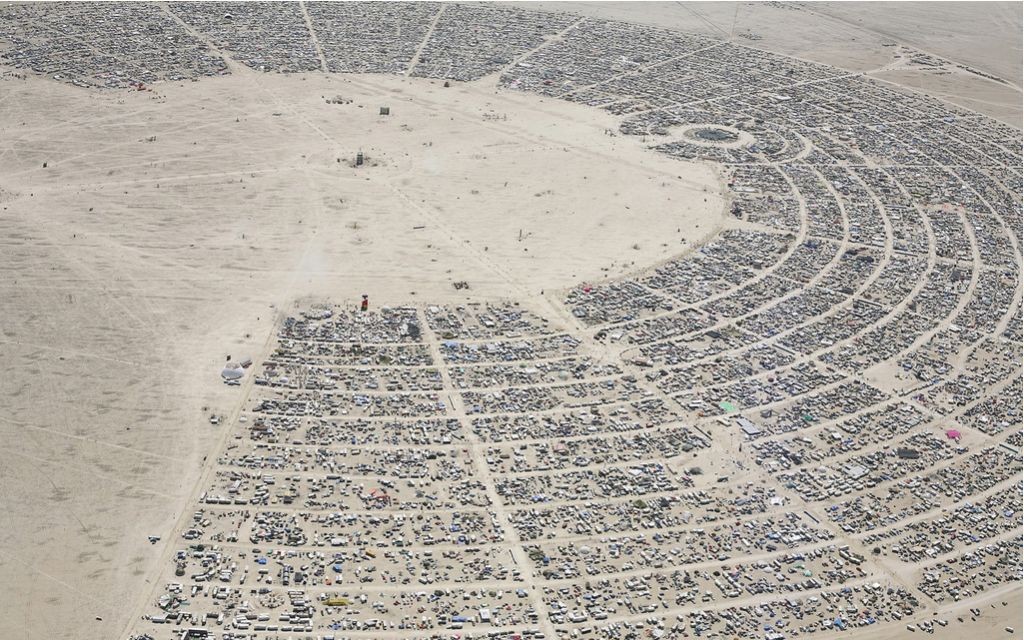

There are some other centers of attraction in the layout, such as a cafe/community center ( a center for talks, small-scale performnances of the hippie arts and the like, and one of the very few places you can spend money). Another is the Temple, which is more for silent contemplation and connection to the higher powers. These two and centers and the main center, the Man himself, are laid out on a central axis.

I have to admit I spent an awful lot of time at the Temple during my one burn – that wouldn՚t have been my conscious choice, there were plenty more fun or interesting places to be than that, but that is where I felt myself pulled. The Man and the Temple are both burned towards the end of the Burning Man week, which determines the temporal side of the large-scale structure of the Burning Man ritual. And, of course, it has the nature of a sacrifice.

Sarah Perry recently published a useful summary of some functionalist approaches to ritual. Such theories are all very well and I՚ve spun them myself, but they are kind of mechanistic and feel external to the phenomenon they are trying to describe. They can explain from an evolutionary standpoint why rituals exist, but they can՚t convey what they are like. Yes, people may perform sacrificial rituals in order to signal commitment and gain status – but that is probably not what they are thinking and feeling while they are doing it. If they are, it isn՚t working – something designed to be directed at lofty communal goals is being perverted into base, greedy, individualistic goals.

And who knows, maybe the vast majority of religious display is infected with this sort of egotistic hypocrisy, but I can՚t believe that it all is. Perhaps I am naive, but it seems to me that people are often quite sincere in their displays of religious enthusiasm – that is, they actually want to participate, they want to be directed at something outside of and higher than their usual concerns, and they are drawn into the ritual based on its nature and their own, not by external compulsions or calculations. Since people are not naturally going to stop engaging in egotistic calculations, part of an effective ritual is that it breaks down individuality. This condition is both terrifying and desirable, and this contradiction underlies some of the weird dynamics of ritual and religion.

It is this desire for transcendence that strikes me as somewhat mysterious, at least in my own case. This mysterious attraction appears to be spiritual in nature. I really hate to use that word, my self-image rejects it. It՚s embarrassing to find myself longing for spiritual experience, to want to be in the sort of place and state of mind in which the individual ego gives way, where the infinite contacts the finite, where the ineffable expresses itself. Such desires don՚t fit in with my self-conception as a realist, pragmatist, materialist, member in good standing of the techno-intelligentsia, and general competent adult.

Maybe It՚s not the spirituality that is embarassing – after all this is California in the 21st century, and everyone is permitted, if not actively encouraged, to engage in all manner of practices. No, it is the longing that is vaguely shameful – at my age, I should just go after what I want, or give it up, all this mooning after the impossible-to-get seems juvenile, especially in the land of do-as-you-please.


But I don՚t think my feelings and reactions are anything out of the ordinary. I may be more conscious of them than normal people, for a variety of reasons, but that doesn՚t make them special. So I conjecture that rituals are structured in such a way as to focus people՚s attention and desire onto something transcendent, that is, something not quite real in the ordinary sense, and thus not really attainable. Longing is built-in to the structure of the sacred.

And if something shameful adheres to the notion of longing, at least a ritual allows people to do it collectively, to align their longings with that of others. Individual longing may be a puerile waste of time; collective longing defines a culture.

[My earlier trip report and an alternative, less weighty view of the nature of the event.]

Wednesday, September 02, 2015

Burning Man Politics

What are the politics of Burning Man? This article claims the event is perniciously libertarian, despite a veneer of communal rhetoric and practices. As you can imagine, that caught my attention, since it arose conflicting passions. I՚m as persistently anti-libertarian as anybody, yet I kind of dug Burning Man, and didn՚t detect any of the things I hate about libertarianism there. There was a capitalist camp, but despite its name it didn՚t seem very paradigmatic of Burning Man as a whole, and in fact they spend a lot of energy apologizing about how they conflict with BM principles. The Black Rock Census says there are about 3 times as many Democrats as Republicans and Libertarians combined, as one might expect.


Burning Man՚s rhetoric of sharing, inclusion, and decommodification makes it sound like a socialist utopia, a radical critique of capitalism, an effort to establish a set of values that are wholly at odds with the accumulationist materialism of the mainstream. They are pretty serious about obliterating the market economy: no monetary transactions are allowed (with two exceptions: ice and coffee are for sale) and you are even expected to tape over corporate logos on clothing or equipment. Gifting is the norm, and participation rather than passive consumption is expected. It might sound like bullshit, but I was pleasantly surprised by how thoroughly and successfully these values are realized in practice.

This attitude coexists uneasily with the huge influx of Silicon Valley money and other rich individuals. Not only hip young tech leaders like Larry Page and Mark Zuckerberg, but the VCs and even Republican moneymen like Grover Norquist have thrown in. The participatory nature of the event appears threatened by so-called “turnkey camps” where rich people pay for fancy RVs and “sherpas” to do the hard work of providing life support and comfort in the harsh desert environment. All of a sudden the elitism of the default world threatens to reproduce itself into this alternative universe that was supposed to be an escape from things like that.

Burning Man has always ben elitist, in a sort of self-selecting way – not an elite of the moneyed, although going isn՚t cheap. While you have to have a certain level of well-offness to participate, it really requires more in the way of freedom than money. Doing it right requires months of preparation, so the real filter is whether you are enough of an independent artist/hipster/whatever to devote your life to something crazy. This very high level of required commitment (of time, money, risk, and discomfort) is a big reason it works at all. Sharing is a lot easier when you know that everyone else is committed to the same craziness you are. Subcultures in general have a problem of getting diluted by hangers-on who aren՚t fully committed as they should be; making you camp out in a remote alkalai desert serves a similar function to a fraternity initiation or gang tattoo – it creates a barrier to entry and forces people to pay for the privilege of belonging. Being there is itself a costly signal of shared values which enable the participants to trust each other more than they would some random on the street.

That՚s the real reason people are upset at turnkey camps, not because rich people are douchebags but because the commitment barrier is threatened. If you can buy your way in, the cultural value of being there is diminished. I don՚t mean to imply that this is mere snobbery: boundaries are important if you are trying to establish a space that is explicitly different from the everyday world. Money eats away at social boundaries, both traditional ones and subcultural ones.

If the issue was just that a great annual desert party and subculture was getting its soul diluted, then nobody but the participants should really care. The article advances the much stronger and more interesting thesis that Burning Man՚s politics mirrors and feeds larger trends in the Silicon Valley culture – libertarian ones basically, the idea that government and democracy is fundamentally broken, that we should rely on the largess of the enlightened rich to provide public goods.

So rather than an egalitarian community of roughly equal sharers, the author sees an aristocracy of the rich providing bread and circuses (literally at Burning Man, figuratively elsewhere) for the masses, mirroring the weakening of democratic institutions and their replacement by the whims of corporate largesse. Mark Zuckerberg՚s intervention in the Newark public schools being an exemplar of this in the default world. Charity is lovely but not a replacement for robust governance, and Burning Man՚s promotion of a gift economy, rather than a harmless image of a better world, actually becomes propaganda for rule by aristocracy and against democracy.

While there may be some truth to this, I don՚t really buy it as a critique of Burning Man, which is simply too huge and overwhelming a phenomenon to be reduced to ideology. The event doesn՚t pretend to be a democracy, it՚s a community with alternative rules and alternative status hierarchies – and being a rich turnkey camper is pretty low status. As far as I can tell, the event still is about insane levels of commitment to art, individualism, and other weirdness, and none of that essential nature is threatened by the presence of some rich people. If they are spectators rather than participants, it՚s their loss, nobody else՚s. That՚s the thing about radical participation, those who participate get to say what something means, those who stand outside watching or critiquing have missed the point.

The attempt to graft a political agenda onto an ecstatic festival reminds me of the rupture in the sixties between the hippie/psychedelic/dropout wing of the counterculture vs. the more politically-minded parts like the anti-Vietnam war movement (I am not quite old enough to have personal experience of this). These two factions never quite got each other, despite their shared opposition to the mainstream. They expressed different values in different ways, although of course many individuals had connections to both camps. The politicos were impassioned humanistc idealists who wanted to change the world by seizing power, the hippies were more like romantic artists, whose strategy for change was self-transformation and personal empowerment. My own favorite sixties heroes were the Yippies like Abbie Hoffman and Paul Krassner, who were explicitly trying to bridge this gap.

Burning Man is way above and beyond politics. It՚s some combination of wild party, transcendent art experience, and temporary autonomous zone, and as such should be taken as an effort to break out of the tedious parameters of default world politics. Not left or right, but orthogonal to that axis, pointing in a direction beyond. Nobody should confuse it with a political movement for social change, despite the idealistic communal values. Like the drugs that are a key component of the experience, it should be considered a temporary alternative state of being, that at best has some tantalizing suggestions for how the regular world could be different.

[ I am missing out on Burning Man this year, instead wistfully and lamely listening to the online radio station and watching the video feed to recapture a bit of the mood. Some part of me is there; some part of it is here with me, trying to express itself. ]

[ Fred Turner՚s excellent paper on the relationship Burning Man and the tech community explores these issues in more depth. Basically he agrees with Jacobin that Burning Man culture and Silicon Valley culture mirror reinforce each other, although he is less focused on the pernicious aspects. ]

Friday, October 03, 2014

The Sacred and the Rational

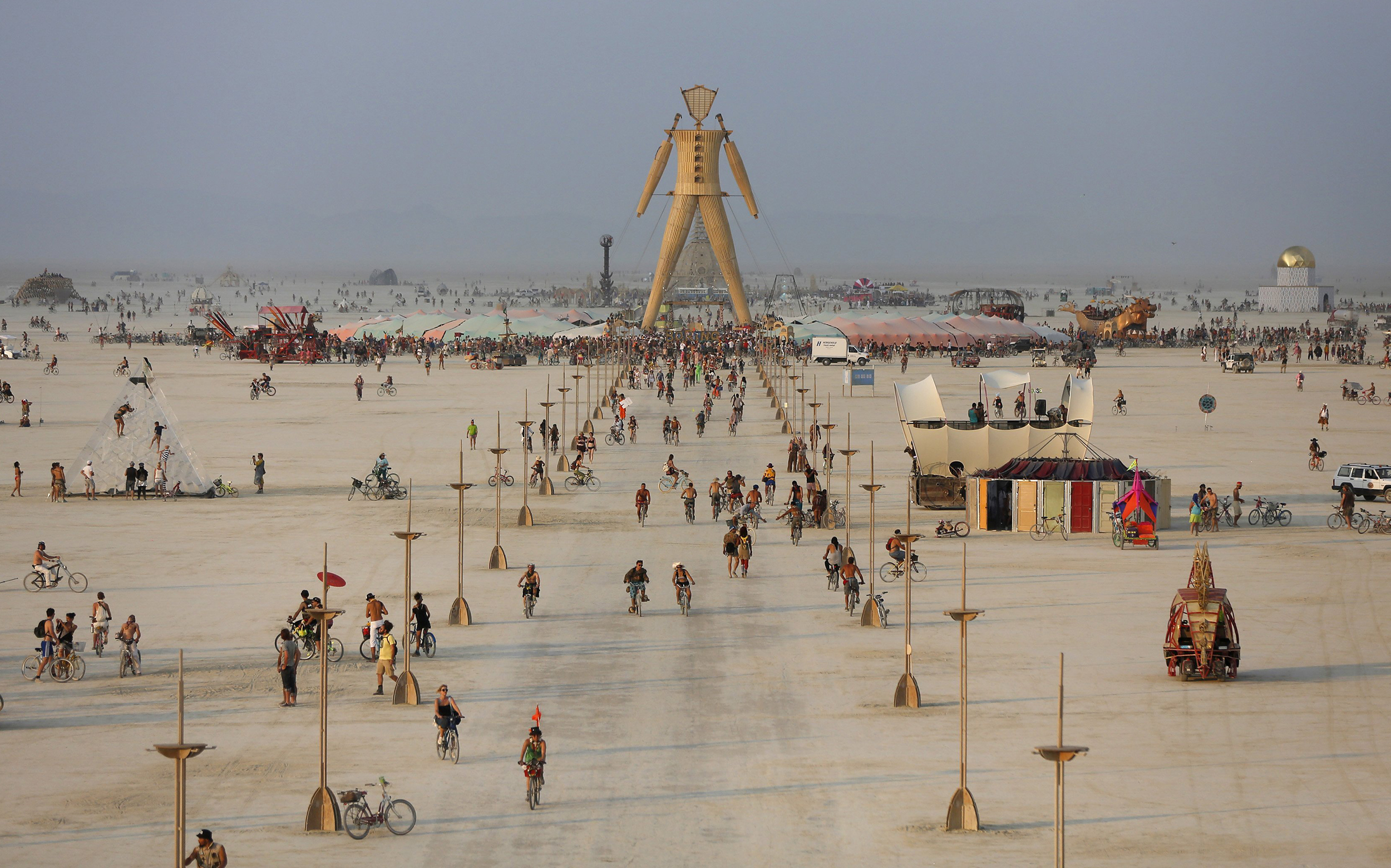
At Burning Man, the Temple of Grace was something like the sacral center to the whole chaotic affair, an oasis of silence and tranquility amidst the noise, a place of meditation, where people went to commemorate and mourn the dead.

I made quite a few visits there, but my first was in the company of some friends, including the one who diagnosed irony in my dancing. He՚s a big-time rationalist, and I had an urge to start an argument/discussion with him there, to grill him on what the rationalist idea of the sacred was, how these two things were supposed to co-exist in his worldview. I did not do this, because that very urge seemed to go against the mood of the place, it would have been an attempt to generate heat and words in a place of calm and quiet. He (I assume) makes his own peace between reason and sacrality, and why should I trouble that peace at that moment? Quieting mental chatter, internal and external, also seems to go hand-in-hand with the sacred.

But I couldn՚t help mull over the opposition in my own mind, and am apparaently still doing so. Reason wants to break down and analyze and measure everything, the sacred exists outside all of that. The sacred is definitionally beyond reason, beyond all forms of contaminating human inquisition. It is that which demands the highest respect, and in that sense is the same for all religions and rituals. You don՚t have to believe in any particular god or creed to recognize it, and if you aren՚t a jerk you respect other people՚s sense of the sacred even when you disagree with their beliefs. It is that which can՚t be argued with. My own tendency to argue with everything gets put on hold (partially and temporarily) in its presence.

It is almost Yom Kippur, the holiest day in the Jewish calendar, and I am going to go be part of that (with the usual doubt and reluctance that apparently doesn՚t matter all that much). Ritual tunes up your relationship with the sacred. It is apparently something I need to do; probably something most people need to do.

Given our multicultural society there is not much that is held universally sacred. The minimal sacred object is personhood, the inner core of every person that deserves respect no matter how wrong, assholic, or fucked up they happen to be. That may not be enough, there is something about the sacred that demands public ritual. But it՚s better than nothing.

Previous Yom Kippur-related posts also seem to touch on this notion of that which is beyond language and reason. Hm. I am getting almost tediously repetitive. Maybe I need to call it a ritual.

Wednesday, September 03, 2014

Trip Report

So I went to Burning Man for the first time, and it was quite as amazing and overwhelming as I had hoped. I don՚t think I՚m going to go into details here. But I have to note that the fundamental thing about this event, which everybody knows but is not often made explicit, is that the whole thing is conceived, designed, built, and populated by people who are tripping balls most of the time (with exceptions). Black Rock City thus mirrors one of the more interesting phenomena of drug use: that a mind (or city) can be completely fucked up and yet still manage to perform most of the necessary operations to sustain daily life. I can՚t quite explain how this works, but in both cases it seems to say something about the robustness of the system architecture, for lack of a better term. A normal computer, by contrast, can՚t tolerate even a single component going wrong.


So having BM in an extremely hostile desert environment is something of a feature. Normal routines of survival are broken down, creating the necessity and opportunity of inventing other ones, that are more improvisational and more distributed. people or things getting fucked up are an occasion to fix them. There are always paths forward, generally not the ones you intended five minutes ago.

Here՚s the calling card I designed for myself beforehand (which, like me, may be a little too intellectual-jokey for the scene):


In that vein, my favorite moment (not the most beautiful or awe-inspiring, but the one that seemed most attuned to my own personal idiosyncrasies) was when I was out riding around with some friends, and we came to a small public square with a large purple phallic sculpture, climbable of course. So I climbed up and poked my head out and started dancing around, yelling look at me, I՚m a sperm. My friend shouted at me (from 30՚ away at least) to “stop dancing ironically, dance for real”. I have no idea what that meant, yet I successfully complied.


On the other hand, the heat, the nonstop electro-rave-whatever music that made it impossible to sleep, and the undertones of hippie self-satisfaction would occasionally combine to make me hate the place. I was hanging out with some much younger people and trying to follow their party schedule did a number on my aging body that՚s going to take a while to recover from. I think it was worth it.

I had multiple camera failures so have no pictures of my own, but on the other hand there is the upside that I didn't spend the whole time viewing things through a lens. A couple of good photo sets here and here. But (and I apologize to my readers for saying this) none of that captures the actuality of being there.