Continued elsewhere

I've decided to abandon this blog in favor of a newer, more experimental hypertext form of writing. Come over and see the new place.
Showing posts with label network theory. Show all posts

Sunday, February 20, 2011

Don't follow leaders, watch the parking meters


Here's a really excellent post by Zeynep Tufekci, a sociologist whose work is new to me, about the emergence of hierarchy and leaders in groups that start out acephalous, with particular applications towards the ongoing revolutions in the Mideast. She cites the iron law of oligarchy, and the underlying dynamic of preferential attachment that generates it. Also the related tendency of movements to coaselse around charismatic authority.
Both of these processes are so widespread in human history that it would be foolish to ever discount them. But to discount them by hoping that social media, as it stands, can provide a strong-counter force would be naïve.
Preferential attachment generates the power-law distribution of connectivity that network theorists have noticed for some time. Social media does not flatten these emergent hierarchies, in fact it makes them much worse:
In fact, if anything, it is quite likely that preferential-attachment processes are part of the reason for the rise of oligarchies and charismatic authorities. Ironically, this effect is likely exacerbated in peer-to-peer media where everything is accessible to everybody.... Thus, networks which start out as diffuse can and likely will quickly evolve into hierarchies not in spite but because of their open and flat nature.
She also mentions The Dispossessed, which treats the question in fiction, showing an anarchist society consciously battling back the emergence of power relations (like me, she had a youthful attachment to the book).

The reality of charismatic leaders is an annoying pheonomenon that I've noticed both in academia and in industry. The people who acheive major success have a certain personal magnetism that verges on magical. The clustering around charismatic leaders is somewhat hidden in academia, but frankly acknowledged business, here for example:
People with a real vision can communicate ideas with almost a spiritual charisma that energizes people around them to go a step beyond normal boundaries, to solve a technical problem, sign on as a team member, or invest resources, when conventional wisdom would suggest otherwise.
I'll admit to being jealous, because (to put it mildly) that's always been a quality I've lacked. So despite being pretty good at some aspects of "the vision thing", I've been frustrated by an inability to sell my visions. I find both leading and following to be highly problematic, but the flat society of The Dispossesed looks like it's going to be a long time coming.

Sunday, March 02, 2008

It's all connected

Well, here's something I didn't know. I wonder what all those losers worried about the pure bloodlines of the West being overwhelmed by the onrush of Muslim hordes think of this:

Mixed in with Queen Elizabeth's blue blood is the blood of the Moslem prophet Mohammed, according to Burke's Peerage, the geneological guide to royalty. The relation came out when Harold B. Brooks-Baker, publishing director of Burke's, wrote Prime Minister Margaret Thatcher to ask for better security for the royal family. ''The royal family's direct descent from the prophet Mohammed cannot be relied upon to protect the royal family forever from Moslem terrorists,'' he said. Probably realizing the connection would be a surprise to many, he added, ''It is little known by the British people that the blood of Mohammed flows in the veins of the queen. However, all Moslem religious leaders are proud of this fact.''

Brooks-Baker said the British royal family is descended from Mohammed through the Arab kings of Seville, who once ruled Spain. By marriage, their blood passed to the European kings of Portugal and Castille, and through them to England's 15th century King Edward IV. '


On our side of the pond, we've got our royal family of Bushies walking hand-in-hand with the Saudis, but I don't know that they've actually mixed their gene pools yet.

Saturday, October 22, 2005

Dangers of isolation & random network thoughts

[not to be confused with thoughts about random networks]

Cosma Shalizi has a nice takedown of Stephen Wolfram's A New Kind of Science, somewhat late for a book that came out in 2002. Back then, I leafed through it casually and my impression was that it was a mixture of self-aggrandizement and old ideas. Now Cosma knows much more about this stuff then I and has actually read the book, and come to much the same conclusion, so two points for my intuition.

Since everything I think these days gets mapped to network theory, the major lesson I draw from this (not very original) is that science is a network of people and ideas, and if you operate outside of that network you are very likely a crank. Wolfram's egomania led him to pull out of the standard networks of scientific exchange and build his own little cult empire. By draining energy from real science, his book is an anti-contribution.

Speaking of science as a network, I recently stumbled upon an issue of PNAS devoted to Mapping Knowledge Domains. Cool stuff, but why isn't there a tool to do this as part of Google Scholar or something? Ok, here is something called HistCite, developed by Eugene Garfield who has been doing this sort of stuff for decades, but it is proprietary and looks kind of ugly to use. Good data though. Really, it's time for Google to take over and conquer this lucrative market. [[update here]]

Hm, Cosma also proposes applying social network analysis to the study of government cronyism, something I was vaguely thinking about myself. As he says, a difficult project to fund.

Thursday, October 13, 2005

And now for something completely trivial

Taking a break from the profound issues of God, death, time, and sociology that we usually deal with here, let me relate a tale: my phone bill this month had a mysterious unexplained charge of $7.39 from "ILD Teleservices". Calling their number revealed, after a 10 minute phone tree and wait, that this charge was from a single 411 call, which apparently gets farmed out from the local carrier to an assortment of unscrupulous company. They agreed to drop the charge after I yelled a bit.

Turns out these people have a history. And the scam is common enough to have its own name, "cramming". Apparently the complex multi-company billing infrastructure of the phone industry is being hijacked to allow all manner of bottom-feeders add any charge they feel like to your bill. Welcome to the world of the future. I imagine there is some sort of differntial pricing going on here, and they try to keep the charges low enough so you won't take the time to complain and try to get the charge dropped, or go to the FCC.

Any ecology (or economy) has its parasites. Networks make new forms of parasitism possible but thankfully they also strengthen the immune system, like that consumer watchdog site linked to above.

Monday, October 03, 2005

Netarchy

For some reason, the term "netarchy" is not being used to describe the social/governmental structures that are going to subverty nasty old hierarchical structures we are saddled with. It is not a totally unknown term but does not appear in google blog search (until now). I'm not even sure what exactly netarchy means, although it sounds attractive. It seems as if it would be a good title for a book by some high-powered internet pundit, which I am not, although I suppose I must have some aspirations in that direction or I wouldn't be blogging stuff like this.

So what the hell is netarchy? Rule by social networks, I guess. It could encompass a wide swath of social network theory, but it's emphasizing that these networks aren't just for chatting, but for coordinating goals, actions, and power. This is the interesting part of SNA (to me) but often seems lost with the emphasis on dating services like friendster or job-finding services like linkedin or marketing tools like visible path. The important social networks are outside of such simple-minded mapping schemes, I'm pretty sure. Something like theyrule.net is a little closer to the mark, but too conspiracy-minded, as is the ridiculous Discover the Network site, beautifully parodied here. Netarchy acknowledges such traditional power-networks, but instead of reacting in horror accepts them as a given and tries to work with them. One way to do this is simply by mapping and talking about the power networks, as the above sites do. Another is by encouraging the formation of counter-networks.

There's a paper by Valdis Krebs called "It's the Conversations, Stupid!" where he points out that ordinary social networks are a strong determinant of voting behavior. A somewhat obvious point, except that most analyses of voting behavior are in terms of individuals, demographic groups, or interest groups. These are not the same as networks, and the network approach provides some interesting strategic insight. Networks already are a big, unacknowledged part of democracy, even if they are not yet acknowledged by changing the name to netarchy. Netarchy encompasses not only the crony networks that are the obsession of conspiracy theorists, but the more bottom-up networks of a functioning democracy.

Netarchy can be used to describe existing political phenomena but may also be used as a guide, or at least a slogan, for generating some new ideas about how to run a society. Maybe it's time to revisit the lovely but rather old-fashioned models of democracy we have inherited. Direct democracy doesn't scale and lacks the damping factors of a separate political class; representative democracy has some of the opposite problems -- elites lead to self-serving corruption. The old science-fiction model of an electronic plebescite voting on issues directly might not be so great, if the model of California's ridiculous ballot propositions is anything to go by. But why not some sort of more flexible network based representation system? How about a website where I can pick new political representatives for myself at any time, rather than at artificial 2, 4, or 6 year intervals? How about if I can pick specific ones for particular issues? I don't have time to study every environmental question in detail, but I'd be happy to be able to designate the Sierra Club or the Viridian Underground as my representative on such questions, with an option to override on specific bills. When it's time to draw up the new constitutions for the Devolved Former States of America, let's try and be open to these and other netarchy-inspired ideas.

Wednesday, September 28, 2005

Social crapital

In the world of social network theory, much is made of the idea of "social capital" -- the notion that the network of social ties constitutes an important and productive form of wealth. This is a totally believable idea, but tends to mask the equally important truth that social networks can be used to do harm as well as good.

This is hardly a new idea -- if you watch any long-running police show like The Wire (best thing on television BTW) you will see the cops making social network graphs of criminal organizations, usually on a funky pinboard, and the better-equipped cops in real life have software to do the same thing. And the concept of netwar has been around for a long time, although apparently the lesson is just now penetrating the heads of our leaders, who, when faced with an distributed asymmetrical enemy, decide to invade a nation because that's what they know how to do.

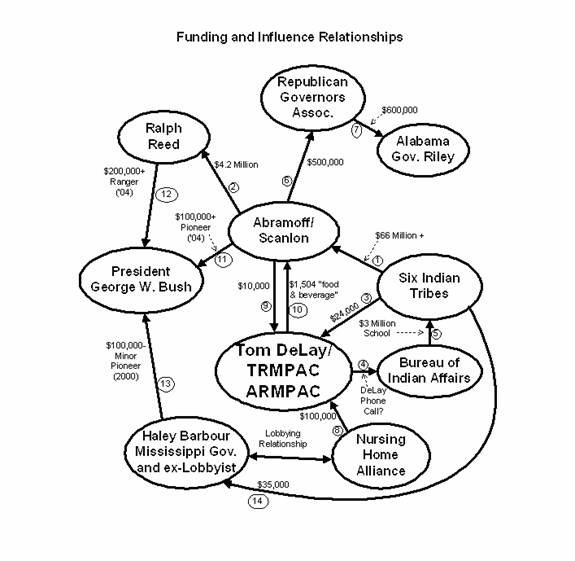
So, that brings me to the inspiration for this post: the sudden outburst of cronyism, or more accurately, of awareness of cronyism. This started building with various Jack Abramoff-related news, peaked with Michael Brown, and is now climaxing as Tom Delay gets indicted, Bill Frist gets investigated, and other exciting news.

Cronyism is the soft form of criminal conspiracy, but it's also not that far removed from the groovier, more celebrated forms of social networking. The much-vaunted networks of Silicon Valley are a crucial form of capital, but they are also crony networks with the attendant downsides of insider deals and quid pro quos for the connected.

Oh hell, I have nothing original to say about this topic except that I coined a lovely phrase to describe what's going on here -- social crapital -- the tool by which the kakistocracy retains its death-like grip on the nation's mechanisms of power. Does not appear in Google so you heard it here first.