Continued elsewhere

I've decided to abandon this blog in favor of a newer, more experimental hypertext form of writing. Come over and see the new place.
Showing posts with label social networks. Show all posts

Saturday, December 28, 2013

2013 Blogyear in Review

This was an unusual year for blogging. Thanks to Venkatesh Rao I got to be a “blogger in residence” at Ribbonfarm, and that occupied most of my writing and thinking efforts. It was a chance to do something more thematic, and I returned to some of the same obsessions I had in graduate school and apparently have not finished with: agency, collective action, personae and social interaction, morality, empathy. Big hairy topics that I have no particular standing to pontificate about, if not for the fact that nobody else seems to understand them very well, including the professionals.

So the home blog only got about half as many posts as usual. However, a few of these managed to go mildly viral, which means they were seen by thousands rather than dozens. That is gratifying, for perfectly normal reasons, although it feels weird to me to actually care about that. Weirdly normal. There should be a word for that.

The Popular 3


The current three most popular posts of all time are from this year, and all actually manage to express a clear and coherent point, which is not always the case. And the points seem worthwhile, or in other words, I think they deserve to be popular; the ideas contained therein seem actually valuable and slightly original, and they ought to be in more people’s heads. All three seem like they could be usefully expanded on and may generate some longer writing in the future.

Hostile AI: You’re soaking in it! develops a theory of human-hostile artificially intelligent systems that already exist. Plays off the LessWrong “friendly AI” people, and advocates that they turn their considerable talents to solving real problems.

Lisp is for Stupid People (nobody noticed my recursive acronym, sigh) was a successful effort to get attention on Hacker News, but there is a serious point there, which is that software developers need to get over their self-image as rock stars of the intellect and acknowledge their limitations. Languages and other tools are designed, usually not very explicitly, to augment the intellect, but if we are more honest about our limitations, we could do much better.

“God” == God leverages Alan Moore to solve forever the tedious argument between atheists and theists, by pointing out that gods are not the kind of things that can be said to exist or not-exist, but are best understood as concepts with actual causal power, a metafiction in Moore’s terminology. I connected this to the different powers words have in written vs oral cultures, and to software, which is a relatively new way to link symbols and causality.

The Idiosyncratic 3


And here are three posts that did not rise in the ranks, and don’t make any stunningly clear points, but I have a fondness for so giving them a small boost:

Engineers of Human Souls I really do believe that social media is reshaping who we are, and I sure wish it wasn’t being done so clumsily. I'm hardly the only one to say this, but I keep feeling a need to say it.

The Opposite of Mathematics How often have you picked up a book on some abstruse intellectual subject (in this case, the relationship between mathematics and narrative) and found someone you know in the subject matter?

Proposed Extensions to the Booleans is a minor rebellion against the constraints of my day job, which has to do with what we in the business call "knowledge representation". Doing this involves taking a very crabbed view of what both knowledge and representation are, but since it’s slightly less crabbed than what usually goes on in computers, it is on the cutting edge and potentially useful. But man, do we have a long way to go.

Wednesday, April 17, 2013

Guest post: Performing ourselves on Facebook

I have a new guest post over at Ribbonfarm on how social media affects our outer personas and effectively our actual being as well.

I can hear the skeptics winding up already. But if you are spending your time having bitter disagreements with people from widely different backgrounds, that you don't know personally, who might be anywhere in the world, then you have already lost this particular argument.

Tuesday, April 09, 2013

Engineers of Human Souls


You have one identity. The days of you having a different image for your work friends or co-workers and for the other people you know are probably coming to an end pretty quickly…. Having two identities for yourself is an example of a lack of integrity.
       – Mark Zuckerberg
This quote from a few years back still amazes me today. If we take it at face value, it implies that some of the fundamental laws and conditions of human existence are being blithely reworked by what are basically naive kids. The kids happen to run a billion dollar corporation, but does Zuckerberg’s technological and business prowess give him a license to not only pontificate about the nature of human identity, but radically alter it? Apparently it does.

Zuckerberg’s childish ideas about how humans work is going to affect hundreds of millions of people and how they interact with each other. Thanks to the wonders of the Internet, you will be forced to give up whatever multiple personas you like to keep on hand for different occasions, and just Be Yourself. In a way, maybe it’s a relief. No more playing roles, you are just you. As Zuckerbergs’s line about “lack of integrity” implies, only the morally flawed would want to hide their true face from the public eye.

Well, fortunately a lot of this is the usual cloud of hot air that hangs over Silicon Valley. Facebook and other social media certainly put a twist on social life and interaction, but do they reach into the deepest recesses of the human mind and change the way we are? I’m not sure. I don’t think Facebook has changed me that much, but I’m old. It may be a different story for those growing up in this media environment. I’m built out of books and bad 1960s television shows; my children are constructing themselves from multiplayer gaming worlds and the like. They will be different.

I do not mind so much that technology changes how we interact with each other and thus how we construct ourselves; that has been happening all the time, every new media technology (print, newspapers, radio, telephone) does that. If the Internet wires us together in a new way, that is OK, it’s not like the particular conditions of the previous social matrix were something especially sacred.

What does bother me is how we are doing this in such an undemocratic, centralized, and corporate fashion. The Internet was designed to be open, free form, and democratic. The web followed those principles and displaced the corporate walled gardens of an earlier era (AOL and Compuserve). Now we seem ready to give all that up and cede control of the very fabric of our lives to Zuckerberg’s walled garden / panopticon because that is where everybody else is, with barely a whimper of protest. It would be bad enough if social media were merely an entertainment playground, but it's builders seem to think it is part of the infrastructure of the new human soul, and they may be right.

[previously] [post title reference]

Sunday, January 20, 2013

Enclosure

Does anybody else find it weird that there should be an academic citation style tied to the offerings of a single company? To me, it seems like a minor but telling episode in the continual erosion of the commons, or more precisely the cultural secession of control of the means of communication to private enterprises.

Minor, in that who really cares about citation styles, especially in light of all the far more significant ways in which corporations have ate away at academia. Telling, in that it means that “tweet” has become part of the general machinery of communication, a generic term like Kleenex or Xerox (or Google) that just happens to be owned by a corporation.

We have accepted tweeting into our lives, just as we have Facebooking and all the other similar platforms for social life. In Twitter’s case, I sort of implicitly trust the company not to do anything too stupid, not to change the rules too drastically (this is in part helped by their radically simplified model). With Facebook, it’s quite the opposite, we are resigned to them changing the rules all the time, knowing that we will grumble and complain and a very few folks will loudly resign from the FB world, and everyone else will go on.

I myself tweeted last year:
sɹəʌɐɹ⊥, əʞıW (mtraven). “Oh please, if FB can "sabotage what it means to be human" then your humanity wasn't much good in the first place. http://t.co/YHwjbn1Y” 30 May 2012, 4:00 p.m. Tweet.
FB won’t make us less human, because human is a very expansive idea, there are many ways to be human. But it does threaten to change human culture in ways we don’t quite understand. It seems roughly analogous to what happens when privately owned shopping malls displace genuine public urban street life – you get something cleaner, more managed, more pleasant in many ways, but also sterile, depoliticized, and subtly or not-so-subtly oriented towards getting you separated from your cash.

Academia is supposed to be an island somewhat isolated from commercial pressures and fads of the moment, the part of society that is able to consider both the long term and the common good. If it was stronger and functioning properly, it would have come up a better way to refer to chunks of social media conversation, something that was more general and more archival.

In this case, they fucked up even the job of setting a standard for Twitter, since they didn’t include the URL or unique id that would have actually made reference possible. This makes me think that there were no technical people involved in this, and it is a case of some poor humanist grudgingly forced to acknowledge a new reality. They would have done better to embrace it more fully.

Friday, July 23, 2010

Orality, Literacy, Privacy, Identity

The ongoing JournaList fracas recalled one of my recent themes, namely, the differing faces we use in different areas of life and how the net threatens to collapse them.

For those not yet saturated in this story, it's roughly this: a group of left-leaning journalists, academics, and politicos had a private email list where they discussed matters of interest. Right-wing operatives managed to get access to the list and are leaking bits out of it that they think are embarrassing. Both sides are accusing the other of ethics violations -- the right is accusing the members of having improperly cozy relations between the press and the people they are covering, and the members are accusing the right of violating their privacy. At least one person has lost their job as a result.

I'm not going to comment on the politics or ethics because that's being done to death elsewhere. Rather, let me dust off my media theorist hat and talk a bit about the nature of online talk. Roughly, this whole brouhaha seems to stem from the fact that email lists (and other forms of electronic communication like Twitter) are somewhere in-between and share characteristics of both oral and literate communications modes. Obviously, they are superficially more like written language than speech, being composed of visual inscriptions rather than sound. And like written communication and unlike speech, they persist indefinitely and can easily escape their original contexts, as the JournoLists discovered. But they are also oral in that they have an immediate quality to them, they are uttered in near-real-time to particular audiences; they are "hot", and tend to be more agonistic than written communication.

The members of JournoList obviously treated the list as an ongoing bull session among like-minded colleagues and friends. And that is a context in which people say things that they wouldn't write into a published article. Contrary to the rightists screaming hypocricy, there's absolutely nothing wrong with this perfectly normal behavior, except that they journos misunderstood the technology, or were not able to accurately predict all the ramifications from their loose talk, like having stray remarks republished by hostile operatives four years later. Some of them said rather nasty things about Rush Limbaugh, for instance.

Here's an interesting attempt to define, as one of the main components of "technological literacy", an appreciation for the utter lack of private spaces for oral-style communication in the modern Internet:
Say you are an employer evaluating college students for a job. Perusing one candidate'™s Facebook profile, you notice the student belongs to a group called "I Pee My Pants When I'm Drunk." What is your first thought?

It should not be that this student is unemployable for being an intemperate drinker, said Susan Zvacek, director of instructional development at the University of Kansas -- though that it might mean that, too. Mainly, though, it should suggest something else -- something that might be more relevant to the student's qualifications.

"œWhat it tells me," Zvacek said, "‚œis that the student is technologically illiterate."
It seems to me that the current state of affairs must be some sort of unstable non-equilibrium. Oral cultures have been around for 10000 years or so, (small) written cultures for a couple of thousand. That's time for rules and conventions to stabilize, but the oral-written hybrid of network communication hasn't had time for that, especially since new variants of it are being constantly invented. Someday it will be understood what is allowed to be said where; there will be techniques for walling off particular kinds of communication so they don't leak out. If I had to put on futurist goggles to go with the media theorist hat, I'm guessing it will be common to have multiple unlinked identities for different purposes. Like I'm doing here. And as here, the identities won't be separated by some kind of cryptographically-secure firewall; rather, they will be more like social conventions, so that what you say in one role can't be held against you in another one.

[the title is a reference to Walter Ong's Orality and Literacy: The Technologizing of the Word which everyone should read.]

Sunday, January 10, 2010

Twittering about twitter

I have a love/hate relationship with social media -- Twitter, Facebook, Reddit, blogs, del.icio.us, etc. On the one hand, they take up endless time, and the information quality and density is generally much less than one gets from traditional media, such as books and journals. On the other hand, just because scholarly journals exist doesn't mean I shouldn't spend time chattering with friends and acquaintances -- in other words, the proper thing to compare Twitter to is, say, an ongoing cafe conversation, not publishing. On the other other hand, Twitter and Facebook are a pale simulacrum of actual face-to-face social interaction. On the other other other hand, so is letter-writing and that technology spawned a great deal of worthwhile instances.

It's a brave new universe and it's still in progress; the rules for formats and genres and etiquette are being explored and seem to change on a daily basis. Worlds are colliding. As a certified Doctor of Media I feel obliged to at least keep track of what's going on and participate a bit, even if it is part of the ruination of intellectual life. I don't really think it is -- or, rather, it is wrecking some parts of the universe of discourse (newspapers, most obviously) and enabling a great many others, and we are a couple of decades away, at least. from seeing how things will ultimately shake out.

One example: I have various services that gate my blog posts onto Twitter and Facebook, and gate Twitter posts onto Facebook. The directionality is significant -- I'd never do it the other way around. Identity is uncomfortable -- the blog is pseudonymous, Facebook is under my real name, Twitter is a bit of both. The mtraven alias was supposed to be decoupled from my real identity so I wouldn't have to worry about professional implications of anything I said here, but eventually I couldn't be bothered to maintain the wall of separation and have been more or less letting it decay or actively undermining it. I can barely be bothered to maintain one persona let alone several.

Aside from the identity discomfort, the flowing-together of these different media also causes other slight irritations -- call it genre discomfor. Something that makes a good blog post doesn't necessarily make a good tweet. For instance, tweets seem more ephemeral than Facebook posts, since the latter have a more explicit mechanism for replying and can become the locus of a conversation. But I undermine the casual nature of Twitter by connecting the two together.

One way to frame thinking about these technologies is to change from thinking of them as a medium to thinking of them as infrastructure. Twitter, for instance, as a medium is kind of stupid -- what possible good can come of a 140-characte limit (on the other hand, haiku). But as an infrastructure -- a utility that supports the controllable multicasting of short messages -- it enables all kinds of unexpected things. My most practical use of Twitter is the Caltrain feed, which allows riders to send reports of train delays, outages, and accidents (which happen with alarming frequency). I have this feed piped to my phone so I typically get better reports of what's going on than the conductors do. I enjoy the mild irony of using this cutting-edge 21st century technology to monitor and improve the utility of the largely broken 19th century technology of railroads.

Google Wave is another new technology that seems really crappy as a medium (if you've used it you know what I mean; if not and you want an invitation let me know), but has great promise as infrastructure. In this case the infrastructure supports the standardization of collaborative applications, ie, it makes it easy to create apps that work like Google Documents do (through the web real-time collaborative editing of documents).

Hm, on further thought there are many subtly different ways to treat these things:
  • medium
  • infrastructure
  • platform
  • ecosystem
  • community
  • standard
For any web technology, these are different and related aspects of the elephant. They all fit together -- standards are useless without a community that is interested in using them; standards once established becomes a platform on which other things are built. Things that start out as new media seem compelled by market forces to become platforms. Etc.

Facebook, for instance, had no appeal for me until some actual people I wanted to communicate with pulled me in (community). Twitter on theo ther hand is more interesting (to me) because of its API. Because it's so trivial, it is developing an interesting ecosystem of clients (like Brizzly and dozens of others), and tools that put different spins on the date such as Twibes and Tweememe. I just learned about a new, interesting, scary part of the Twitter ecosystem a site that lets you add sponsored links:
Ad.ly automatically inserts one tweet from an advertiser that you approve into your feed every other day.
Here's my own (pretty trivial) contribution to the Twitter ecosystem -- Twitlines, a client that uses a scrollable timeline. The idea is to create an ambient view This was done mostly as an experiment to test out how quickly I could deploy a web app in the new universe of platform services (answer -- very quickly, but tweaking it into shape was starting taking too much time so I am forcing myself to release it to the wild). More interesting variations to come, I hope.


The profusion of multiple standards and platforms is a symptom of the youthful stage of the Internet. It's pretty healthy, if annoying, to have so many different growth points.

Oh well, this post has turned into the opposite of a tweet, which is necessarily pithy and pointed. If I have a point, it's that these media are going to be the nervous system of the planetary collective mind, like it or not, and radically shape whatever civilization we might have in the future, just as the printing press shaped the Enlightenment. So it won't do to dismiss them as trivial, even though 99% of the contents may be just that.

Sunday, February 01, 2009

Report from Davos

I decided to skip Davos this year so am relying on reports like this one (via Whiskey Fire which has pointers to much more).

Two interesting factoids from this article: One, $25 trillion in market value has evaporated in the current financial crisis. That's a lot! Of course, the right interpretation is not that this much value vanished, but that that's how much fake value was hallucinated by an insane system that is now coming off of some kind of analog of a drug binge.

The other factoid is that you, dear reader, ar just as much to blame for this mess as the more obvious culprits, according to one of the economic luminaries at Davos:
One Davos regular, Washington-based Carlyle Group’s managing director David Rubenstein, said he thinks a key issue at this year’s gathering is “who is at fault.” Yet Rubenstein, who was saying at Davos two years ago that the outlook for leveraged buyouts was “very robust,” says responsibility shouldn’t be tied only to him or his industry.

“There are six billion people on the face of the earth, and probably about five billion participated in what went on,” Rubenstein said in an interview. “Everybody participated in some way or shape or form.”
BTW, if I were inclined to be a conspiracy nut, the Carlyle Group would probably be one of the major nodes in the network graph I maintained in crayon on my apartment walls. Oh wait, the internet is my wall.

Thursday, January 01, 2009

Social Media Notes

The blogosphere and new media are another war zone, we have to be relevant there.
-- head of the IDF Press Team, via

This ain't no disco! The Air Force has "Rules of Engagement" for blogging. The mind boggles. It looks as if they copied these from somewhere else, the block on dealing with "Unhappy Customers" is a bit off. They also have a Twitter feed.

Speaking of Twitter, I'm playing with it more lately thanks to a plethora of different intefaces, including TweetDeck, an Emacs interface!, Twitterrific on the iPhone. Nothing like being able to do something useless four different ways! I set up TweetDeck to collect all tweets containing "gaza", which seem to be about 10 a minute or so. Also "supervolcano", so I will be notified quickly if the world comes to an end. Plus I'm following Al Jazeera's Gaza feed and one put out by the Israelis. I still don't see the point. 140 character utterances can't help but be either grunts or at best fingerpointing via a URL to something interesting. People are actually arguing over Gaza in this format, which seems purpose-built to ensure that such conversations are going to be even more unproductive than they usually are.

I've gated this blog onto Twitter via TwitterFeed. This makes me feel peculiar in terms of identity management; the twitter version of mtraven has more connections to my real-world identity than this blog. Oh well, we'll see how it goes.

Of all the Social Media foo stuff I've seen, FriendFeed seems the most interesting and contentful. It brings in actual content items from just past the edge of your own network (ie, stuff friends of friends have posted).

Meanwhile, David Gelertner has proposals for using technology to create "parent-chosen, cloud-resident learning tracks" sounds just right to me, I've been talking about stuff like this for awhile, mostly to myself, but maybe it will happen.

Friday, January 27, 2006

Social networks and reputation in Russia

People interested in social networks and reputation systems ought to come here. Everything seems to get done by virtue of knowing somebody who knows somebody. We got into the opera at a reasonable price because it was arranged by Katya, who told us to meet Grigori at the door, who got us in at the native rate for a small surcharge (he either works at the theater, or knows someone there). Katya is a hub -- she runs the office of the company we work with, is in charge of sheparding foreigners around and much else. She carries three cell phones for her own use and has a bunch more she hands out to her charges, so she can tell them that Sergei will pick you up at 10 and deliver you to Alexi, etc. Sergei has been driving us around, at one point we had to decide whether it was safe to leave a couple of laptop cases with him. Turns out it is, because he gets lots of work from Katya and has a good reputation and it would be silly for him to jeopardize this healthy business relationship (another driver the company used didn't get the system and was summarily disconected from the network).

An American who lives here got laughed at by the Russians when he went to get his car inspected -- turns out that everybody else knows somebody whose cousin runs an auto shop and will sign the papers for you sight unseed, for a small fee.

It's pretty clear this elaborate informal network evolved so that people could operate a real economy while the official one choked on its own bureaucracy and corruption. This two-layer approach seems to have persisted past the fall of communism. I wonder if it impedes or helps the development of a full-blown capitalist economy. Or which is better. The favor-network sounds kind of nice, but is prone to corruption of its own and can shade off into organized crime, which is also plentiful here.

My seatmate on the flight here was reading a thick Max Weber book (in German). I vaguely recall that one of Weber's theses was that modern societies evolved away from this kind of informal network into more formalized, rationalized, bureaucratic structures. Given the history of such structures here, it's not surprising people prefer a more underground approach.

Sunday, November 06, 2005

Arguing Economics

In olden days when the Internet was populated only by nerds, I used to have a pastime of arguing with libertarians. Sometimes these were just stupid fights, but occasionally they were enlightening, at least to me. It helped me sort out my own political opinions, and realize that my naive communitarianism was impractical and markets were an excellent tool for resource allocation, some of the time. I was not, however, converted to the culty libertarianism that was the rpevailng ideology on the net, which is essentially that markets are in every situation the best and only mechanism for resource allocation and every other social process there is.

One of the people I used to argue with was Eric Raymond, who later went on to be a famous author and proponent of the naive communitarianism known as Open Source. I don't know if arguing with me had any influence on him, but I like to think so. He's still ostensibly a libertarian despite being one of the leading proselytizers for a very successful form of socialism.

I long ago tired of arguing with ideologues, but every so often the impuslse surfaces again. Nowadays it's different thought -- I can bash on famous economists with bestselling books, rather than unwashed basement-dwelling geeks. Twice now (that makes a trend) I've had to chasten Steven Levitt, the Freakonomicist, for applying his deformation professionelle to get obviously absurd results. The latest was on the occasion of today's column in the New York Times maagazine, where he (and partner Stephen Dubner) presents his mystification as to why people should vote. I and many others take him to task for taking an inappropriate stance to this issue, and I point to Valdis Krebs' paper on social networks and voting as a more interesting and meaningful way to look at voter turnout issues. But maybe the best comment was from GamblingEconomist:
If millions of people vote and the standard economic model predicts that people should not vote, the problem is probably with the model not with the people.
An earlier posting of Levitt's dealt with Peak Oil and energy issues (inexplicably vanished from his site, link is to Google cache), which he dismissed with the wave of the magic wand of the markets -- prices will rise, demand will drop, equilibrium will be achieved and all will be well. I pointed out that the speed at which this happens matters a lot -- slow changes in prices allow time to adjust, rapid price increases will cause a lot of pain. Actually it was my attempt to respond to this that ended up in the creation of this blog, so I guess I owe them.

OK, my critiques are not exactly flashes of genius, more like flashes of common sense. Still, it would be nice to know what Levitt's response to them would be. I haven't seen that, because blogs+comments are really not the kind of conversational mechanism that mailing lists and usenet are/were. This is a peeve of mine about the blogging medium, it doesn't really support conversations that well. Comments generally suck -- there are too many (or in some cases not enough), no structure, no quality control, and no conversational structuring.

Partly it's the power-law effect -- the network in the old days was a flatter space, where anybody could wade into the conversation and get an argument going. Now that the web is a reflection of the outer social world, we are back to having celebreties and nonentities, although the barrier between them is perhaps more permeable. There is no way that Levitt could respond to all the people who would like to argue with him even if he wanted to.

Well, maybe the answer for me is to stop trying to debate people who are both a) too high up the curve and b) aren't really saying stuff that's new/relevant. For an amateur political economist, the folks over at Crooked Timber, ie, are both more accessible and more interesting.

Monday, October 03, 2005

Netarchy

For some reason, the term "netarchy" is not being used to describe the social/governmental structures that are going to subverty nasty old hierarchical structures we are saddled with. It is not a totally unknown term but does not appear in google blog search (until now). I'm not even sure what exactly netarchy means, although it sounds attractive. It seems as if it would be a good title for a book by some high-powered internet pundit, which I am not, although I suppose I must have some aspirations in that direction or I wouldn't be blogging stuff like this.

So what the hell is netarchy? Rule by social networks, I guess. It could encompass a wide swath of social network theory, but it's emphasizing that these networks aren't just for chatting, but for coordinating goals, actions, and power. This is the interesting part of SNA (to me) but often seems lost with the emphasis on dating services like friendster or job-finding services like linkedin or marketing tools like visible path. The important social networks are outside of such simple-minded mapping schemes, I'm pretty sure. Something like theyrule.net is a little closer to the mark, but too conspiracy-minded, as is the ridiculous Discover the Network site, beautifully parodied here. Netarchy acknowledges such traditional power-networks, but instead of reacting in horror accepts them as a given and tries to work with them. One way to do this is simply by mapping and talking about the power networks, as the above sites do. Another is by encouraging the formation of counter-networks.

There's a paper by Valdis Krebs called "It's the Conversations, Stupid!" where he points out that ordinary social networks are a strong determinant of voting behavior. A somewhat obvious point, except that most analyses of voting behavior are in terms of individuals, demographic groups, or interest groups. These are not the same as networks, and the network approach provides some interesting strategic insight. Networks already are a big, unacknowledged part of democracy, even if they are not yet acknowledged by changing the name to netarchy. Netarchy encompasses not only the crony networks that are the obsession of conspiracy theorists, but the more bottom-up networks of a functioning democracy.

Netarchy can be used to describe existing political phenomena but may also be used as a guide, or at least a slogan, for generating some new ideas about how to run a society. Maybe it's time to revisit the lovely but rather old-fashioned models of democracy we have inherited. Direct democracy doesn't scale and lacks the damping factors of a separate political class; representative democracy has some of the opposite problems -- elites lead to self-serving corruption. The old science-fiction model of an electronic plebescite voting on issues directly might not be so great, if the model of California's ridiculous ballot propositions is anything to go by. But why not some sort of more flexible network based representation system? How about a website where I can pick new political representatives for myself at any time, rather than at artificial 2, 4, or 6 year intervals? How about if I can pick specific ones for particular issues? I don't have time to study every environmental question in detail, but I'd be happy to be able to designate the Sierra Club or the Viridian Underground as my representative on such questions, with an option to override on specific bills. When it's time to draw up the new constitutions for the Devolved Former States of America, let's try and be open to these and other netarchy-inspired ideas.

Wednesday, September 28, 2005

Social crapital

In the world of social network theory, much is made of the idea of "social capital" -- the notion that the network of social ties constitutes an important and productive form of wealth. This is a totally believable idea, but tends to mask the equally important truth that social networks can be used to do harm as well as good.

This is hardly a new idea -- if you watch any long-running police show like The Wire (best thing on television BTW) you will see the cops making social network graphs of criminal organizations, usually on a funky pinboard, and the better-equipped cops in real life have software to do the same thing. And the concept of netwar has been around for a long time, although apparently the lesson is just now penetrating the heads of our leaders, who, when faced with an distributed asymmetrical enemy, decide to invade a nation because that's what they know how to do.

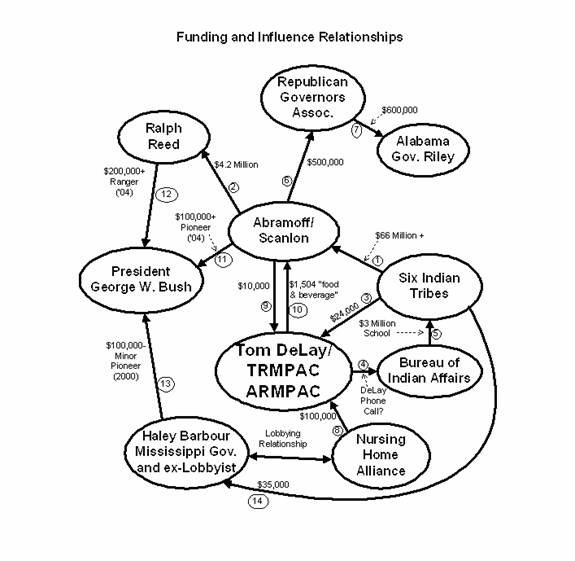
So, that brings me to the inspiration for this post: the sudden outburst of cronyism, or more accurately, of awareness of cronyism. This started building with various Jack Abramoff-related news, peaked with Michael Brown, and is now climaxing as Tom Delay gets indicted, Bill Frist gets investigated, and other exciting news.

Cronyism is the soft form of criminal conspiracy, but it's also not that far removed from the groovier, more celebrated forms of social networking. The much-vaunted networks of Silicon Valley are a crucial form of capital, but they are also crony networks with the attendant downsides of insider deals and quid pro quos for the connected.

Oh hell, I have nothing original to say about this topic except that I coined a lovely phrase to describe what's going on here -- social crapital -- the tool by which the kakistocracy retains its death-like grip on the nation's mechanisms of power. Does not appear in Google so you heard it here first.

Tuesday, September 13, 2005

Link Gumbo

I'm still feeling out this blogging medium. Here are a bunch of random yet worthwhile links:

Excellent kids-say-the-smartest-things story, and this guy wins the I-wish-I'd-thought-of-that-blog-title-and-especially-the-subheading award.

Speaking of I wish-I'd-though-of-that, I did think of the idea of having a website that tried to build social networks around books, reviews, and book chat. Never got around to doing anything about this fairly obvious idea, but somebody finally has.

I'm discovering all sorts of wonderful blogging/tagging/etc sites. It's a Cambrian explosion of software out there, and I sure don't have time to keep track of it (fortunatly there are plenty of others who do). Here is one that I like a lot, Tagcloud, which gives you a sort of terminological overview of what's going on in your personal blog collection. Here's mine., and here's another of mine that's built around the more technical/scientific blogs I read.