Continued elsewhere

I've decided to abandon this blog in favor of a newer, more experimental hypertext form of writing. Come over and see the new place.
Showing posts with label war. Show all posts

Tuesday, August 05, 2014

Refactoring War


I seem to be obligated to have an opinion of some sort on the current fighting in Israel and Gaza. I am, after all a politically engaged and intellectual sort of person, or claim to be. All sorts of people I know are weighing in on one side or the other of the conflict. Some are quick to assign blame, others make heroic efforts to construct a balanced view where moral faults are parceled out to both sides in accordance with a detailed and sensitive knowledge of the history of the region. (Here՚s the best of those efforts I՚ve found so far, from none other than Amos Oz). I have family and co-workers in Israel, so am pulled in that direction, yet I am temperamentally and politically drawn to support the underdog, and that is not Israel in this fight. So I can՚t easily choose a single side for condemnation or support. But being balanced requires putting more time than I am willing to invest into learning all the agonizing details.

I could just shut up, of course, and mostly I have, because the situation seems to be definitionally hopeless. And my meta-heuristics say to stay away from hopeless topics, no matter how much they seem to want to pull me in. I՚m starting to see some merits in the LessWrongian slogan “politics is the mind-killer” – war and politics are after all basically two variants of the same thing, and while politics may kill the mind, war kills actual people as well. Why join in? If I thought there was some actual good to be done by expressing an opinion, that would be one thing, but the only benefit seems to be the very minor satisfactions of moral posturing, and the downside would be losing friends.

But silence is not really a viable option for me, for a multitude of reasons, social, moral, whatever. Doesn՚t matter – as Trotsky said, you may not be interested in war, but war is interested in you. So that means having to have an opinion, and that largely means figuring out how to assign blame. Isn՚t that what people really want to know when they raise this subject? They want to know which side to root for, as if it were a football game or pro wrestling or something.

Consider this post an effort to assign blame while avoiding picking a side. And there will be blame, someone or something has to answer. But using our patented refactoring technology may help us find different culprits than usual. And actually being unable to settle on a stable good guys vs bad guys story helps me out, in that it helps me to reflect in as abstract a way as I can manage on the nature of conflict in general. Abstraction is sort of what I do for a living; if there՚s any useful contribution I can make, it has to lie in that direction.

I came up with a refactoring of conflict a while back, a kind of childish and obvious idea really, but I keep it in my intellectual toolbox. Instead of seeing a conflict as between the two ostensible sides, view it as a battle between those who profit from war on both sides and those who are victimized. So in Vietnam the war was not between the US and the communists, but between the warriors on both sides, the military industrial complex in the US and the corresponding war machines of Russia, China, and their allies – and on the other, people trying to live their lives. Sometimes people trying to live are forced to enlist in this battle; hence the anti-war movement. Again, this isn՚t a particularly new idea – during the Vietnam era this was known as “the war at home” – but I rarely see it made explicit, and I haven՚t thought of as a refactoring until just now.

So instead of focusing on the ostensible conflict, focus on the internal conflict between warmakers and peacemakers. The dynamics become pretty visible in something like the Palestinian conflict, where both sides at one time contained a mix of hardliners and more reasonable people, but it was a lot easier for the hardliners to escalate the conflict than for the peacemakers to de-escalate it. Such escalation raises the relative status of the hardliners within their own side, so they have an interest in keeping the conflict going. As a result the Israeli peaceniks like Oz have had their power and stature diminished. In this other war, Hamas is Netanyahu՚s best ally and vice versa.

I՚m sorry, I՚m trying to keep this on as abstract a plane as possible, trying to suss out the utilitarian algebra that generates conflict in general, not this conflict in particular. I shouldn՚t even mention the actual warriors, I՚ll just get myself in trouble, even though I՚m very carefully avoiding even momentarily taking one side or another.

I am very partial to stories about heroic mutinies, like this one about how German workers ended WWI. And related stories that reveal the fractures within aggressive coalitions, like this one about what MPs are really for. It supports my refactoring story, obviously, and makes it possible to see the noble and peace-loving people being manipulated into conflict by their status-seeking superiors. I don՚t know how well this mythology can be applied to the Middle East, though; the very real ethnic hatred seems to be pervasive, not merely a creation of the violence entrepreneurs. Of course Israel is self-selected for Jews who want to turn ethnicity into political/military power – those are the ones who were drawn there (my uncle went there fleeing Nazi Europe; my mother and father turned west and went to England and the US). Palestinians too are probably self-selecting for collective belligerence – the ones who were individualistic and capable emigrated rather than join in ethnic warfare. Part of what makes this fight intractable is that it isn՚t all that refactorable. But people have tried.

A further refactoring occurs to me. In both the normal and refactored framing, we still tend to think of individuals being on one side or another. Jew or Palestinians, hawk or peacenik, it is a question of membership. But a more enlightened and even more refactored view is that everybody has a version of the war-making machinery in them, and peace-making as well, although either may be well-hidden. Then war is seen not as some external conspiracy of a few people against the many but an expression of tendencies we all have. Sometimes the machinery behind those tendencies simply gets the upper hand.

This is also not a terribly original idea. It is, after all, one of the bases for the nonviolent techniques of Gandhi and King, the idea that all humans have a conscience which can be reached.
King’s notion of nonviolence had six key principles. First, one can resist evil without resorting to violence. Second, nonviolence seeks to win the ‘‘friendship and understanding’’ of the opponent, not to humiliate him. Third, evil itself, not the people committing evil acts, should be opposed….
cards_warisnothealthy_detail.jpgI think back to my childhood, where I was a very junior participant in the movement against the Vietnam war. These sappy posters were everywhere:

The sixties anti-war movement soon moved on from such sweet thoughts into more aggressive forms of opposition. Partly due to increasing pushback by the government and assassination of its prophets of nonviolence, but also because peace is too wimpy a cause to rally around. The only ones who can make war on war without becoming as bad as the thing they aim to defeat seem to be backed by a religious faith which I don՚t share. I could never really see myself as a flower-bearing peacenik, I՚m too contentious by nature, no saint. And more importantly, an approach to politics based on sainthood doesn՚t seem like it is workable, that it could scale.

On the other hand saints do appear on occasion. Somehow we normals have to figure out what to do in the meantime.

It is interesting that religion seems to be the ultimate glue holding coalitions together, whether they are sides in an ethnic war or a movement against war.

Buddhists seem to have their own refactoring of conflict, at least, they talk a lot about aggressive qualities of mind as a distinct thing which can be noticed and worked on and eliminated (or at least tamed to the point where it is non-destructive). Personally I am reluctant to give up my anger, it seems too fundamental to my being, to how I think. The world is full of things that deserve anger, should I let them all slide just for my own peace of mind? I would hate myself if I could no longer hate appropriately.

Still there is something to be said for getting aggressiveness under control, for learning to wield it as a weapon against targets that matter, including itself.
But vain the Sword & vain the Bow
They never can work Wars overthrow
The Hermits Prayer & the Widows tear
Alone can free the World from fear 
For a Tear is an Intellectual Thing
And a Sigh is the Sword of an Angel King
And the bitter groan of the Martyrs woe
Is an Arrow from the Almighties Bow
The hand of Vengeance found the Bed
To which the Purple Tyrant fled
The iron hand crushed the Tyrants head
And became a Tyrant in his stead 
— from “The Grey Monk”, William Blake
[This post owes something to a recent and widely read post on Slate Star Codex (my favorite blog right now) about how narrow interest-seeking on a large scale makes the world shitty. I՚ve been trying to work up a response; this is not that response but some influence has crept in. ]

Wednesday, July 09, 2014

Strategies Against Architecture

In my recent posts I՚ve given the impression that I view academic critical theory as somehow lightweight, airy-fairy, and impractical, at least when measured alongside the sturdy simple souls who do engineering. Well I take it all back. You can՚t get much more pragmatic than the IDF, and they are down with this stuff in a big way, apparently:
The attack conducted by units of the Israeli Defence Forces (IDF) on the city of Nablus in April 2002 was described by its commander, Brigadier-General Aviv Kokhavi, as ‘inverse geometry’, which he explained as ‘the reorganization of the urban syntax by means of a series of micro-tactical actions’....
Contemporary military theorists are now busy re-conceptualizing the urban domain. At stake are the underlying concepts, assumptions and principles that determine military strategies and tactics. The vast intellectual field that geographer Stephen Graham has called an international ‘shadow world’ of military urban research institutes and training centres that have been established to rethink military operations in cities could be understood as somewhat similar to the international matrix of élite architectural academies. …

There is a considerable overlap among the theoretical texts considered essential by military academies and architectural schools. Indeed, the reading lists of contemporary military institutions include works from around 1968 (with a special emphasis on the writings of Gilles Deleuze, Félix Guattari and Guy Debord), as well as more contemporary writings on urbanism, psychology, cybernetics, post-colonial and post-Structuralist theory. …
Naveh, a retired Brigadier-General, directs the Operational Theory Research Institute… ‘We are like the Jesuit Order. We attempt to teach and train soldiers to think. […] We read Christopher Alexander, can you imagine?; we read John Forester, and other architects. We are reading Gregory Bateson; we are reading Clifford Geertz. Not myself, but our soldiers, our generals are reflecting on these kinds of materials. We have established a school and developed a curriculum that trains “operational architects”.’ In a lecture Naveh showed a diagram resembling a ‘square of opposition’ that plots a set of logical relationships between certain propositions referring to military and guerrilla operations. Labelled with phrases such as ‘Difference and Repetition – The Dialectics of Structuring and Structure’, ‘Formless Rival Entities’, ‘Fractal Manoeuvre’, ‘Velocity vs. Rhythms’, ‘The Wahabi War Machine’, ‘Postmodern Anarchists’ and ‘Nomadic Terrorists’, they often reference the work of Deleuze and Guattari.… 
Indeed, as far as the military is concerned, urban warfare is the ultimate Postmodern form of conflict. Belief in a logically structured and single-track battle-plan is lost in the face of the complexity and ambiguity of the urban reality. Civilians become combatants, and combatants become civilians. Identity can be changed as quickly as gender can be feigned: the transformation of women into fighting men can occur at the speed that it takes an undercover ‘Arabized’ Israeli soldier or a camouflaged Palestinian fighter to pull a machine-gun out from under a dress.… 
Critical theory has become crucial for Naveh’s teaching and training. He explained: ‘we employ critical theory primarily in order to critique the military institution itself – its fixed and heavy conceptual foundations. Theory is important for us in order to articulate the gap between the existing paradigm and where we want to go. Without theory we could not make sense of the different events that happen around us and that would otherwise seem disconnected.… 
Naveh references such canonical elements of urban theory as the Situationist practices of dérive (a method of drifting through a city based on what the Situationists referred to as ‘psycho-geography’) and détournement (the adaptation of abandoned buildings for purposes other than those they were designed to perform). These ideas were, of course, conceived by Guy Debord and other members of the Situationist International to challenge the built hierarchy of the capitalist city and break down distinctions between private and public, inside and outside, use and function, replacing private space with a ‘borderless’ public surface. References to the work of Georges Bataille… also speak of a desire to attack architecture and to dismantle the rigid rationalism of a postwar order, to escape ‘the architectural strait-jacket’ and to liberate repressed human desires.
This is by far the weirdest thing I՚ve read recently. The whole article has a slightly unbelievable air to it, as if it was extracted from a Don Delillo or JG Ballard novel. The intrusion of a subfield of computer science that I have a tenuous connection to (swarm intelligence) adds to the unreality.

(h/t to Jordan Peacock, who has written a quite useful introduction to Deleuze and Guattari at Ribbonfarm)

[Addendum: some commenters missed the tone of the post and the cited article, which was awed but not exactly approving. And yeah, the use of radical philosophy (and even more so the work of the radically humanist Christopher Alexander) for the purposes of military occupation may be perverting it.]

Monday, May 26, 2014

Memorial Day 2014

I have a tradition here on the blog of grappling with holidays that don՚t really work for me the way they are supposed to. It՚s not celebrating them exactly, but it is doing them a bit more honor than just going shopping or firing up the grill.

On Memorial Day, where we are supposed to be thinking of those who gave their lives for their country, I tend to think of those whose lives were impacted by war in all the other possible ways besides being a soldier – being a victim, for instance, or refusing to participate, or finding a larger cause to dedicate themselves to. I guess there is an element of snobbery there, for which I apologize. But it՚s also a function of my background – my father was a Czech Jew who served in the British Army during WWII, and I came of age during the Vietnam era, which did not inspire much patriotic war fever. So like many vaguely leftish people, I am in the position of trying to love my country while hating the larger part of what it does.

But the day is about the people who sacrificed, not the cause they sacrificed for. I think of them enlisting, with enthusiasm or trepidation or a simple sense of duty. It՚s an alien experience for me, and I admit to a surprising touch of envy: to immerse yourself so totally in a collective cause must be liberating in a way. We all must serve something greater than ourselves; how convenient to have that need packaged up in an institution for you. Us draft-dodger types have to work hard to figure out what we are fighting for and how to fight for it, and most of our efforts are dissipated by lack of effective institutions. The war against war involved some real risk too, and I՚m glad those who died in that struggle have a memorial. But on this holiday, let us forget the sides, the countries, the causes, the enmities, and think about what binds together all those who have risked themselves to fight for something they believed in.


Some of those beliefs may have been wrong, stupid, or evil, but I give the grunts the benefit of the doubt: they may have enlisted in a bad cause for good reasons. Finding yourself betrayed by your own bad judgement is one of the risks of war.

Here's a veteran describing with controlled anger his treatment at the hands of the VA. This issue has gotten plenty of airing lately; I don't have much to add. But it occurs to me that this country no longer has a functioning upper class. If I was a member of the aristocracy (say, a scion of an old WASP family like the Bushes) I think I'd take some pains to take care of veterans, given that I expect further generations of the working class to go risk their lives for my interests. Given that we treat them like dirt, I can only assume that either nobody is running the country, or the people who do feel that they don't have much need for soldiers. Or, and I think this is the most probable and most terrifying, there are people running the country but they have not got a clue about how to protect either their own or their country's real long-term interests.

Wednesday, June 19, 2013

Guest post: war, agency, killer robots, hostile systems

I have a new guest post up at Ribbonfarm which hits some of my usual issues: collective agency, war, morality, etc. It generalizes a bit from this earlier post into a theory (well, a proto-proto-theory) of human-hostile systems, which seems like an important concept.

Saturday, August 27, 2011

Libertarians for slavery

At this point I should be jaded, but I still get a little chuckle when I find the gods of libertarianism devoting their efforts to defending some of the most brutal enemies of human freedom. Here we see Murray Rothbard musing over Just War theory and deciding that the only ones he approves of are Revolutionary War and "the War for Southern Independence". That is, he is happy to support the collective rights of slavers over the individual rights of slaves, who barely register in his consciousness.
In 1861, the Southern states, believing correctly that their cherished institutions were under grave threat and assault from the federal government, decided to exercise their natural, contractual, and constitutional right to withdraw, to "secede" from that Union. The separate Southern states then exercised their contractual right as sovereign republics to come together in another confederation, the Confederate States of America. If the American Revolutionary War was just, then it follows as the night the day that the Southern cause, the War for Southern Independence, was just, and for the same reason: casting off the "political bonds" that connected the two peoples. In neither case was this decision made for "light or transient causes." And in both cases, the courageous seceders pledged to each other "their lives, their fortunes, and their sacred honor."
...
we must always remember, we must never forget, we must put in the dock and hang higher than Haman, those who, in modern times, opened the Pandora’s Box of genocide and the extermination of civilians: Sherman, Grant, and Lincoln.

Perhaps, some day, their statues, like Lenin’s in Russia, will be toppled and melted down; their insignias and battle flags will be desecrated, their war songs tossed into the fire. And then Davis and Lee and Jackson and Forrest, and all the heroes of the South, "Dixie" and the Stars and Bars, will once again be truly honored and remembered.
via. He has a grain of a point -- the rise of a strong federal government made it possible for the US to spend the next 150 years building the military empire we have today, which is also anti-freedom. But the cause of southern slavery is the worst argument possible against federalism.

Seeing libertarians like these guys and Bryan Caplan write about war is kind of painful. I presume they own a little chunk of real estate like the rest of the middle class -- are they under the impression that their title doesn't squat over an ocean of blood? That because they obtained their little territory by sitting down in a realtor's office rather than swinging a sword, it doesn't represent a conquest over other people who might have thought they had a right to live there?

Saturday, July 30, 2011

National greatness and its opposite

Took the kids to see the Bay Model in Sausalito, a huge scale-model of the hydrological systems around San Francisco Bay, built a long while back by the Army Corps of Engineers. They are refurbishing it so it was empty of water, which somewhat diminished the experience. It's also a bit fusty around the edges since it is no longer needed for its original purposes, having been replaced by computer models. The Sacramento-San Joaquin Delta is an incredibly important and incredibly fragile piece of California's infrastructure (a good part of it is under sea level and protected by old, fragile levees, likely to collapse soon even without taking climate change into account). The Bay Model doesn't much go into the politics of water in California, although anyone who's seen Chinatown (or better, read Cadillac Desert) knows how much the two are linked.

But this post isn't about water, it's about a side-exhibit there on the Marin shipyards which used to be on the site where the model is located, which were thrown together in WWII and began churning out Liberty Ships at a rapid rate (one of the films shows that as one ship was being launched, they were already lowering part of the keel for the next one into the construction bay). People were drawn into the area from all parts of the country and all walks of life, with housewives being trained as welders overnight, black sharecroppers pouring in from the South. It was an incredible coordinated effort. It took a mere three months from deciding where to site the shipyard to starting lay steel in. Hard to imagine today.

I couldn't help contrasting the spirit that animated this effort with the current deadly stagnation in Washington, where even raising an arbitrary numerical limit seems to be impossible, let alone actually doing something. There is not even a hint of a shared national spirit, some grand project that could get people working together on the vast scale seen during the war. The calls to mobilize seem to fall on deaf ears.

Of course the war efforts were unencumbered by environmental constraints or much respect for individual rights. And while national greatness sounds a lot better than national stagnation, it seems as if it's usually a byproduct of war, the most destructive and wasteful thing in the world. Greatness may not be worth it.

Monday, May 30, 2011

The pointy end of the spear

[Previous Memorial Day posts here, here, here]

I watched Dr. Strangelove with my kids the other day (me for the umpteenth time, they for the first), and, since I knew it so well, could focus on some of its less obvious qualities. Like the looks, how perfectly it captured some of the era's technology and design aesthetic. And how it treated humans bound up into technological systems that escaped their creators. In particular, the crew of the bomber, little human fleshopoids that travel along with the aeronautical and nuclear technology and guide it along, towards their own destruction.
The technology seems rather quaint, coming as it does at a too-early stage of the control revolution, where you had to have actual humans close to the weaponry. Having humans in the loop means unreliable control, and unacceptable cost. Nowadays our nuclear deterrent is based largely on ICBMs, where the humans are far from the destruction. More significantly, remote-controlled drones are becoming the weapon of choice, also pushing humans back from the front.

War, up until recently, involved groups of men carrying sharp sticks running into each other. Technology like cannons and armor and fortifications made some differences, which were very important in context (even something as simple as the stirrup is supposed to have played a significant role in the spread of feudalism), but it didn't change the basic way in which humans were immersed in violence. They were of necessity, close to it.

With the coming of the industrial age the balance started to change. The technology of destruction became too powerful for humans to withstand, and too complex for humans too control. This became obvious in WWI, but not really remediable until recently. Now we can have wars without soldiers, nobody but our enemies needs to risk anything worse than carpal tunnel syndrome. We've already removed most of the visible economic costs of war from the public consciousness, the human cost is the next to go.

Well, not quite. We are still getting a solider or two killed per day in Afghanistan, for no apparent reason. We're supposed to start withdrawing them in a few months, also for no apparent reason. Perhaps in the next war we'll have eliminated the need for memorials.

Monday, May 16, 2011

Volunteered slavery

I suppose if I didn't have a real job and a real life I might devote myself to critiquing the George Mason economics department. I already seem to spend an inordinate amount of time doing that. My defense is that when it comes to bashing libertarians, at least I'm picking on some of the most prominent, ones who are well-respected academics as well as popular in the blogosphere, public intellectuals (of a sort). And they are also one tentacle of the Kochtopus, so there's that, I feel like I'm doing my small part to battle this fearsome monster. There's also the alarming fact that this libertarian tendency has been seeping into mainstream discourse for decades and is a large part of what is making the institutions of government completely dysfunctional.

Anyway: Bryan Caplan is one of those people who even when I agree with his conclusions, I feel like he's wrong. Here's a post where he asserts that "conscription is slavery" (echoed by Robin Hanson, my other bete noire). Now, I am no fan of conscription or the military. But there's clearly something wrong here, if only because this has exactly the same form as the standard libertarian assertion that "taxation is theft", and there's clearly something wrong with that. So I wrote in a comment:
Conscription is slavery in exactly the same way that taxation is theft: that is, it isn't really, except in the most superficial form of analysis. And just as your precious bank account is not really yours in some cosmic, absolute, and unqualified way, neither is your body or self, it turns out. The government gets to take a slice of both. Why? Because it's the government.

The way people around here and Hanson's blog use the idea of status is fairly obtuse. Instead of saying "people have a very strong innate bias for government over firms", maybe you should enquire as to why that is.

If you are an anarchist, then OK, you can complain about government all you want. If not, then you really can't whine when it comes around to collect the bill.
To expand on the cryptic second paragraph, Caplan should check out his colleague Daniel Klein's paper The People's Romance. He's just down the hall (I imagine). This paper outlines a reasonably good theory of why governments exist, why people align themselves to it, and why that's important to the functioning of society.

The larger point: the only reason libertarians can maintain their stupid ideology is because they are, almost uniformly, white middle-class suburbanites who are almost completely isolated from the violence necessary to prop up the state that maintains their pampered little lives. They don't go to prison, they don't go off to fight in wars. And they don't actually fight the government, as real radicals do, and thus they never feel its wrath.

The core of libertarianism (and most other anarchist tendencies) is to take the fact that modern societies have more or less granted government a monopoly of violence and "coercion", and reason from there that if only we got rid of government, we'd get rid of the violence. The error here is completely obvious once you've thought about it for ten seconds, yet the idea won't die. Anarchists are like atheists -- they define themselves by what they claim not to believe in.

Libertarianism always involves a corruption of language. They took the perfectly good word "libertarian" and co-opted it to mean an apologist for power, and Caplan is busy trying to do exactly the same thing for "pacifist", so that it no longer means someone deeply committed to non-violence, who will risk their life for the principle, but just someone who thinks in the abstract that war is bad. Is Caplan going to lie down in front of a troop transport? I think not.

So does the fact that Bryan Caplan doesn't like conscription mean I have to be for it? Not really. But there's one somewhat good argument for it -- it democratizes the costs of war, and thus may dampen the tendency of states to go to war. That dynamic certainly was active during the Vietnam War era, and is absent now. If states are inevitable, then wars are inevitable, and the best way to keep it in check might be to make sure everyone has a risk of being killed, or forced to kill. Or else forced to become actual pacifists, conscientious objectors who will actually risk something for their principles.

[update: some unrelated George Mason shenanigans. And it appears that the next Commerce Secretary may come out of the Mercatus Center? WTF?]

Wednesday, December 22, 2010

Go tell the Spartans

In honor of the repeal of DADT, here's Bill Hicks:


Yes, it's a great thing that homosexuals now have the same opportunities to become cogs in a relentless machine of imperial conquest as the rest of us. A real step forward.

I am straight and so not really entitled to an opinion, but I think I preferred it when gays were transgressive rather than determined to be normal middle-class people with marriages and jobs, including jobs in the bureaucracy of violence and death. But I suppose nobody really wants to live as an outsider if they can avoid it; it is difficult and risky and you can't get health insurance. So gay people have fought for and largely won the right to be normal, which is good for them perhaps, but leaves society short of strangeness.


[[Update: Here is IOZ on the idea that gays and women in the miltary will somehow make that institution more warm and fuzzy:

The military...is a vast metaphoric rape machine, a big hard thing shoving itself in where it isn't wanted. To waste time pondering how "feminine traits" like "intercultural dialogue" ... can be further incorporated to help "stabilize" the world's Afghanistans, so that we can teach their backward cultures what it would be like if they "privileged, remunerated and valorized the care and feeding of functional future citizens in the same way that [they] valorize soldiering," is to avoid the rather more pertinent question: what are we doing there in the first place?
]]

Wednesday, September 22, 2010

I'm not saying we wouldn't get our hair mussed

I saw a talk by Richard Rhodes last night at the Long Now. Rhodes recently published his fourth book on nuclear weapons; I've read the first two and they are great. The theme of this latest is somewhat more hopeful now that the idea of nuclear weapons seems to be in decline. A couple of highlights from the talk:

- most of the destruction of a nuclear strike comes from fire effects rather than the blast or radiation, which affect only a fairly small radius. But the heat is enough to set a whole city ablaze. One prediction is that if India and Pakistan have a "small" nuclear exchange with 50 Hiroshima-sized weapons apiece, that would be enough to cause a mini-nuclear winter effect approximately the same as a a major volcanic eruption, and with the global food system as stretched as it you might see a billion deaths from starvation.

- all world leaders quickly realized that nuclear weapons were basically unusable. He quoted Khruschev:
When I was appointed First Secretary of the Central Committee and learned all the facts of nuclear power I couldn't sleep for several days. Then I became convinced that we could never possibly use these weapons, and when I realized that I was able to sleep again.
So as a result, nuclear weapons development is basically a very expensive signalling game (7.8 trillion during the period 1948-1991 according to his estimate).

- The idea that a state would develop a nuclear capability and then hand it off to a terrorist group is just silly.

I don't know, personally I have moved on and don't give much thought to nukes any more and haven't for years. Bioterrorism is a lot more scary, because unlike nukes the development technology is accessible to non-state groups and getting more so all the time.

The short feature before the talk was this nice little visualization of all the (terrestrial) nuclear explosions since Trinity:

Friday, July 16, 2010

Dancing on the Edge

Today is the 65th anniversary of the Trinity test, the first successful nuclear detonation. As it says here, this did indeed change the world forever and is one of the few technologies that can legitimately make that claim (the Internet may be another). It did put a halt to direct great power wars in favor of proxy wars in third-world backwaters. Nonetheless, what soldier or statesman could resist the temptation of such awesome powers? The results of Hiroshima and Nagasaki might have made nuclear war unthinkable for most, but not all. Some moments from nuclear history where we danced close to the edge:

- MacArthur wanted to use nukes on North Korea, but was restrained by Truman;

- the Cuban missile crisis, of course;

- the incident in 1983 where a Soviet officer violated protocols to avert a mistaken retaliatory strike;

-
Nixon's longing to use nuclear weapons on North Vietnam, restrained by Henry Kissinger ("œA nuclear bomb? Does that bother you? I just want you to think big, Henry, for Christ's sakes. You worry about the civilian casualties. I don't give a damn.")

- Tactical nuclear weapons were deployed in Western Europe as a defense against a possible Russian invasion (and apparently are still there);

- It's been alleged that the Bush/Cheney administration was putting plans in place for a nuclear strike on Iran.

As I said the other day, it's somewhat miraculous that we are all still here.

Also, this:

it would be so exciting
it would be so powerful
it would punish us for our sins
things wouldn't be so boring anymore
we could get back to basics
we could remember who we love
it would be so loud
it would be so hot
the mushroom clouds would rise up
we could start over
we wouldn't have to be afraid of it anymore
we wouldn't have to be afraid anymore
we would finally have done it
better than Raskolnikov
it would release our anger
in the ultimate tantrum
then we could rest

Alia Johnson, 'Why We Should Drop the Bombs', 1981

[update: stumbled on this:
"Restraint! Why are you so concerned with saving their lives? The whole idea is to kill the bastards! At the end of the war, if there are two Americans and one Russian, we win!"

--Thomas Power, commander in chief of the Strategic Air Command from 1957 to 1964, quoted by Fred Kaplan, The Wizards of Armageddon
]

Monday, May 31, 2010

Support the nontroops

Today we take time to honor those pacifists, deserters, AWOLs, refuseniks, Yossarians, Švejks, self-wounders, conscientous objectors, draft dodgers, hippies, misfits, fake ministers, fake homosexuals, mutineers, etc, who for selfish or principled reasons managed to avoid becoming part of the machinery of war.

Not being privy to the mind of god I don't know who is the more morally upright, the soldier who goes to war for his country and community, or the indivdual who opts out. Maybe it depends on the country, and the war. Maybe it depends on the reason for opting out. But I do know that if everyone opted out, we'd all be better off.

"Colonel Cathcart is our commanding officer and we must obey him. Why don't you fly four more missions and see what happens?"

"I don't want to."

"Suppose we let you pick your missions and fly milk runs?" Major Major said. "That way you can fly the four missions and not run any risks."

"I don't want to fly milk runs. I don't want to be in the war anymore."

"Would you like to see our country lose?" Major Major asked.

"We won't lose. We've got more men, more money, and more material. There are ten million men in uniform who could replace me. Some people are getting killed and a lot more are making money and having fun. Let somebody else get killed."

"But suppose everybody on our side felt that way?"

"Then I'd certainly be a damned fool to feel any other way, wouldn't I?"

-- Joseph Heller, Catch-22

[Last year's similarly-themed Memorial Day post]

Sunday, December 06, 2009

Afghan Highs

For some reason these two bits of intel on Afghanistan seemed worth putting side by side.

First: Afghanistan is not a country; but a collection of tribal areas. It may be defined as that part of central Asia that has historically been resistant to conquest by empires. One unifying factor is that most of the men are constantly stoned on the locally produced high-potency opium and hashish.


(via Digby) Is this accurate? Dunno, sounds plausible, if I had to live in the Afghan tribal areas I'd probably want to be high most of the time. On the other hand, it's hard to square this picture with the Afghani's reputation as fierce fighters.

So, that's a view of Afgahnistan from the ground level. Meanwhile, perched on the commanding heights of a modern-day massive bureaucratic war machine, the American would-be benevolent rulers get high on insane business graphics (via Yglesisias). Something this fucked up could only be generated by people who were huffing too much white-board marker fumes.


Full PDF report here. I have an ongoing debate with a colleague about the value of graphics and visualizations, including some tangled network diagrams like this which are common in systems biology. I'm generally pro-pretty-pictures, but this is a great piece of evidence for his side. Measurement is pretty tricky in biological systems, but at least you know there is something real going on that could in theory be measured, like the amount of mRNA being made off a particular gene. In this chart, you have somthing like "coalition force density" -- which presumably could be an objective number, albeit not a very meaningful one -- is combined with variables like "indivdual competence, judgement, and ability to execute" and "ANSF Corruption & Tribal Favoritism", which can't possibly be defined tightly enough to be measured. So what is the point of this, other than to highlight what a hopless morass fighting a counterinsurgency warfare in mountainous country half a world away where we don't speak the language, understand the culture, or have an idea for an endpoint or exit strategy? None of those arrows point to an exit.

Wednesday, November 11, 2009

Veterans Day

For the Union Dead

Relinquunt Omnia Servare Rem Publicam

The old South Boston Aquarium stands
in a Sahara of snow now. Its broken windows are boarded.
The bronze weathervane cod has lost half its scales.
The airy tanks are dry.

Once my nose crawled like a snail on the glass;
my hand tingled
to burst the bubbles
drifting from the noses of the cowed, compliant fish.

My hand draws back. I often sigh still
for the dark downward vegetating kingdom
of the fish and reptile. One morning last March,
I pressed against the new barbed and galvanized

fence on the Boston Common. Behind their cage,
yellow dinosaur steamshovels were grunting
as they cropped up tons of mush and grass
to gouge their underworld garage.

Parking spaces luxuriate like civic
sandpiles in the heart of Boston.
A girdle of orange, Puritan-pumpkin colored girders
braces the tingling Statehouse,

shaking over the excavations, as it faces Colonel Shaw
and his bell-cheeked Negro infantry
on St. Gaudens' shaking Civil War relief,
propped by a plank splint against the garage's earthquake.

Two months after marching through Boston,
half the regiment was dead;
at the dedication,
William James could almost hear the bronze Negroes breathe.

Their monument sticks like a fishbone
in the city's throat.
Its Colonel is as lean
as a compass-needle.

He has an angry wrenlike vigilance,
a greyhound's gentle tautness;
he seems to wince at pleasure,
and suffocate for privacy.

He is out of bounds now. He rejoices in man's lovely,
peculiar power to choose life and die –
when he leads his black soldiers to death,
he cannot bend his back.

On a thousand small town New England greens,
the old white churches hold their air
of sparse, sincere rebellion; frayed flags
quilt the graveyards of the Grand Army of the Republic.

The stone statues of the abstract Union Soldier
grow slimmer and younger each year --
wasp-waisted, they doze over muskets
And muse through their sideburns

Shaw's father wanted no monument
except the ditch,
where his son's body was thrown
and lost with his "niggers."

The ditch is nearer.
There are no statues for the last war here.
On Boylston Street, a commercial photograph
shows Hiroshima boiling

over a Mosler safe, the "Rock of Ages"
that survived the blast. Space is nearer.
When I crouch to my television set,
the drained faces of Negro school-children rise like balloons.

Colonel Shaw
is riding on his bubble,
he waits
for the blessed break.

The Aquarium is gone. Everywhere,
giant finned cars nose forward like fish;
a savage servility
slides by on grease.

-- Robert Lowell, 1964

I have almost no personal connection to the US military -- my father served in the British Army during WWII, and I was too young for Vietnam, although not to protest it. It bothers me that there is this huge machinery of violence that claims to be acting for me. The usual stance of today's left is to try to distance themselves as far as possible from the military, but there's an element of dishonesty in that, as if war could be vanquished by keeping our individual hands clean of it. Like the state, we can't embrace it and we can't live without it. Today is for those who made or found themselves part of the business end of the machine, whatever the reason.

Related:

The Sacred State, Memorial Day, War Sucks, Iraq Casuality Memorial.

Friday, September 11, 2009

9/11

Yes, let's memorialize the 3,000 or so Americans (and others) who died in the attacks of 9/11, but only if we also remember the 4343 American soldiers who died in the course of waging a wholly unnecessary and ill-conceived war in the wake of 9/11. And, of course the roughly 100,000 Iraqi civilians who have died in the course of that war.

I'm trying to refrain from political thinking today, in the hope that that will be the best way to honor the dead. The vast majority of the dead indivduals above probably weren't that interested in politics, religion, or war, and just wanted to live their lives. But as Trotsky said, "œYou may not be interested in war, but war is interested in you." Choosing sides is always necessary; the best we can do is be on the side that is against conflict.


Monday, May 25, 2009

Memorial Day

Two items for all of those caught up and destroyed by the periodic death spirals that our species specializes in.

Random thought: I remember having one of those minor flashes of illumination about how the world works when I was reading something about WWI -- maybe it was Hemingway -- that described the role of the Military Police in warfare, which was chiefly to prevent desertion by arresting or shooting those soldiers who did not feel like participating in the collective death machine. All of a sudden one part of the institutional structures that make war possible was clear to me. A soldier on the front lines with his gun and bayonet has a structure of violence behind him as well as in front of him; he has a gun to his back wielded by his "superiors" to deal with, as well as those of the enemy. Here's an article about those who try to break out of this trap.

When you see millions of the mouthless dead
Across your dreams in pale battalions go,
Say not soft things as other men have said,
That you'll remember. For you need not so.
Give them not praise. For, deaf, how should they know
It is not curses heaped on each gashed head?
Nor tears. Their blind eyes see not your tears flow.
Nor honour. It is easy to be dead.
Say only this, 'They are dead.' Then add thereto,
'Yet many a better one has died before.'
Then, scanning all the o'ercrowded mass, should you
Perceive one face that you loved heretofore,
It is a spook. None wears the face you knew.
Great death has made all his for evermore.

Charles Sorley (1895-1915)


Tuesday, April 28, 2009

War Music


This weekend I went to a preview of the phenomenal new ACT production War Music, a modern reinterpretation of the Illiad based on the translation (or retelling, really) of Christopher Logue. This is a very powerful piece of poetry, with a percussive meter that was used to good effect in the staging.

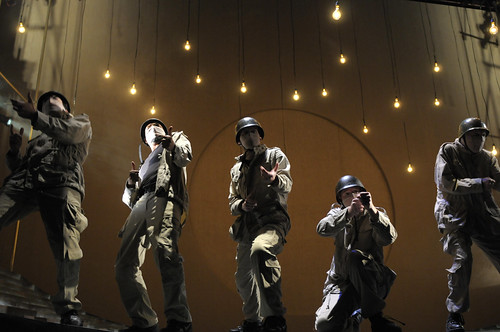
About a dozen or so actors took on about 40 different parts, and mostly wore identical costumes based on present-day military desert fatigues, with small variations (the Greeks had red berets, the Trojans blue -- the gods wore carnival masks). This made the complex story harder to follow than it had to be.

The gods were played in a comical style which was very effective in conveying their vanity and caprice, although this sometimes went overboard into farce (Poseidon wearing a diver's mask and flippers, for instance).

The set was a minimalist-modern set of risers, with a golden model of the city of Troy set at the back of the stage. I thought that the presence of the sea was indicated very effectively by the use of large billowing cloths. Lighting was also quite effective, especially the use of a multitude of bare bulbs like traced fire that descended during a battle scene. Despite the name, music was not a very prominent element in the show.

This play seems to have gotten rather poor reviews, and I'm not sure why -- perhaps because it isn't structured much like a traditional play. It's really a dramatic reading of a poem, and the poetry is the strongest element of the production. So, here are the opening verses. It seems the only way I can actually manage to slow myself down enough to give poetry a decent reading is by saying it aloud, or by retyping it.

Picture the east Aegean sea by night,
And on a beach aslant its shimmering
Upwards of 50,000 men
Asleep like spoons beside their lethal Fleet.

Now look along that beach, and see
Between the keels hatching its western dunes
A ten-foot-high reed wall faced with black clay
And split by a double-doored gate;
Then through the gate a naked man
Whose beauty's silent power stops your heart
Fast walk, face wet with tears, out past its guard,
And having vanished from their sight
Run with what seems to break the speed of light
Across the dry, then damp, then sand invisible
Beneath inch-high waves that slide
Over each other's luminescent panes;
Then kneel among those panes, beggar his arms, and say:

"Source, hear my voice.
God is your friend. You had me to serve Him.
In turn, He swore: If I, your only child,
Chose to die young, by violence, far from home,
My standing would be first; be best;
The best of bests; here; and in perpetuity.
And so I chose. Nor have I changed. But now--
By which I mean today, this instance, now --
That Shepherd of the Clouds has seen me trashed
Surely as if He sent a hand to shoo
The army into one, and then, before its eyes,
Painted my body with fresh Trojan excrement."

Sometimes
Before the gods appear
Something is marked:
A noise. A note, perhaps. Perhaps
A change of temperature. Or else, as now,
The scent of oceanic lavender,
That even as it drew his mind
Drew from the seal-coloured sea onto the beach
A mist that moved like weed, then stood, then turned
Into his mother, Thetis', mother lovelost face,
Her finger, next, that lift his chin, that push
His long, redcurrant-coloured hair
Back from his face, her voice, her words:

"Why tears, Achilles?
Rest in my arms and answer from your heart."

The sea as quiet as light.

Random connection: Christopher Logue is on record as calling war "a criminal activity", which echoes Charles Tilly's paper War Making and State Making as Organized Crime, found via recommendation by reader bhyde. Me talking about the similarities between governments and organized crime were what got me started arguing with Michael S, back on Mencius Moldbug's blog. It's all connected, somehow.

Saturday, April 18, 2009

The organization of (non)violence

Both Gandhi and the Palestinans have come up in conversation here recently, so I have to post this: The Missing Mahatma: Searching for a Gandhi or a Martin Luther King in the West Bank, by Gershom Gorenberg (who blogs at South Jerusalem, which is where I found this). It takes a look at the (fairly dim) prospects of Palestinians taking up the strategy of nonviolence that was successful in the hands of Gandhi and King. He finds a few figures in the Palestinian world who might have taken up that role, but for the most part any movements in that direction have been sabotaged, either by more violent Palestinian factions or by Israel. Saints are in short supply.

This fits into my own intermittent thinking on polarization and the dynamics of conflict. Peacemakers are a threat to those who proft from war on both sides. I previously noted that there are standard intra-group conflicts between warmakers and peacemakers. In this particular case, because of the control one side has over the others' affairs, warmakers in Israel were able to reach across the conflict and sabotage a potential peacemaker on the other side.

The mechanics and dynamics of group solidarity and group conflict seem endlessly fascinating, the kind of thing that raises interesting questions that most people can't even recognize as issues. It seems perfectly natural that Israel and Arabs should go to war, or France and Germany should go to war. But "Israel" and "the Arabs" are composed of individuals, who have or ought to have their own goals and agendas. What makes people ready to sacrifice themselves for a group? Suicide bombing is only an extreme case; every solider has been convinced (or coerced) to risk his life for the good of a larger whole. The extroardinary level of social cooperation in humans is matched in the animal kingdom only by the social insects. They too, spend a lot of their energy on war. But the level of cooperation in ants and bees has a genetic explanation. Human groupings, for war and more noble purposes, rely on something else, something that can make abstraction seem worth dying for.

Reflecting on my current sniping with Gagdad Bob and his minions. My mild efforts to tone down the conflict have been unsuccessful. We are bitterly insulting each other, the internet equivalent of war, and over what? Abstractions called "left" and "right", which can't even be defined consistently. Nonetheless they are terribly real in their effects. So is the abstraction called "God", another cause of many a war:


Which led me to this piece, which I remembered reading when I was 12 years old or so.
The only thing that's been a worse flop than the organization of nonviolence has been the organization of violence.
The years have not diminished its shocking clarity.

Wednesday, August 20, 2008

World War III 2.0

Ooh, goody, sabre-rattling with Russia! Grand alliances, evil empires forward siting of nuclear missles! If the 80s are coming back, maybe the Talking Heads will get back together. Actually the current situation seems to blend elements of WWs III and I, as we'll see.

I find it somewhat disturbing when I read a Pat Buchanan piece (esp. when it's at Lew Rockwell's site) and find myself nodding at his sagacity. But even better on the war in Georgia is Billmon, who has quietly returned to blogging after a long hiatus. Both writers point out how the US had a hand in stirring up this shit. Among the many nuggets in Billmon's piece is the revelation that Congress had passed something called the "NATO Freedom Consolidation Act", which enables the US to treat Ukraine and Georgia as full-fledged NATO allies in all but name. Might this make the Russians a little antsy? Apparently so. Who could have known?

Hardnosed realists at Stratfor point out that this minor war simply serves as a signal of a shift in the balance of power that has already occured.

And of course Jim Kunstler jumps in with a word about how its going to bring our financial system crashing down. If he keeps on saying that eventually he'll be right.

Chris Floyd muses that the US deliberately encouraged Georgia to attack, essentially hoping for a Russian reaction that would enable more sabre-rattling at home, giving a boost to warriors in US politics, notably John McCain:


However, at this point, it is still unlikely that Butt-Thumper and the gang will actually take a pop at the Russians. But they don't have to, not right now. The racheting up of tensions, the resurrection of the mega-profitable Cold War tropes, and the convenient burial of the huge, fetid mountain of Bush Regime crime -- torture, aggression, corruption, tyranny -- by a juiced-up media with a new conflict to play with: all of these will serve the militarists very nicely, thank you.


I have no problems at all believing that the motivation and will to do something like this exists; but I have some doubts about whether the current administration is capable of being that strategically devious.

What's the other side saying? Here's Michael Gerson, a reliable gauge of offical neocon opinion (h/t IOZ):

The worst option would be to excuse Russia by blaming ourselves. NATO expansion did not cause Russian belligerence. The desire to be part of NATO in liberated Europe was fueled, in part, by a justified fear of Russian belligerence. ....
Georgia has been foolish. But Russia's crude overreach has had one good effect -- revealing the courage of others. Poland has quickly upgraded its relations with America, even under nuclear threat from Russia. Ukraine has been defiant, even though Russia still makes claims on Crimea. These nations have recent memories of Russian national "pride." And their courage should provoke our own.


Oh yeah. There's battle lines being drawn / And no one's right, if everybody's wrong.

More Gerson:

Again and again in European history, there has been a temptation to sacrifice the freedom of small countries to the interests of great powers. And it generally hasn't worked out very well, for them or for us.

Oh yes, and pulling small countries under the blanket of great power alliances in an atmosphere of saber-rattling has worked out so wonderfully in the past.

Well, this at least returns this post to one of the consistent themes of this blog, which is the dynamics of militarization and polarization. Militarists everywhere create the justifications for militarism everywhere else. We can see it happening here. McCain the militarist ought to be sending Saakashvili and Putin muffin baskets, at the very least.

The reality of this dynamic is perfectly obvious to me at this point, maybe because I've been obsessing about this idea for years. What's less obvious is how much the players in these games are aware of the dynamics versus how much they are simply being pushed around by them. Do militarists genuinely want war? I suppose they do. If it's what you are good at, it's what you want. Firemen would be bored and depressed without fires, and so they occasionally go and create some. Similarly warfighters must needs be warmakers, shit-stirrers, conflict-amplifiers. Like the fireman-arsonists, they probably don't mean for things to get out of hand, but they always do.

[[update: Jim Henley caught a Wall Street Journal article that highlights the financial aspect, which is of course a hugely important driver of all this:


Russia's attack on Georgia has become an unexpected source of support for big U.S. weapons programs, including flashy fighter jets and high-tech destroyers, that have had to battle for funding this year because they appear obsolete for today's conflicts with insurgent opponents...

Some Wall Street stock analysts early on saw the invasion as reason to make bullish calls on the defense sector. A report from JSA Research in Newport, R.I., earlier in the week called the invasion "a bell-ringer for defense stocks."...

Now, the Russian situation makes the debate over the equipping of the U.S. military a front-burner issue. "The threat always drives procurement," said a defense-industry official. "It doesn't matter what party is in office."


Ah, well. All my nattering about dynamics and I'm ignoring the most important driver of all, namely money.]]

Monday, May 26, 2008

War sucks

To be specific, war is a vortex of destruction that sucks in human beings, territory, and material, until it burns itself out. Or a paired set of mutally-reinforcing vortices.

Conflict is a pervasive part of human existence, but only some of the time does it rise to the level of armed conflict. Just as we always have weather, but only under certain conditions does it self-organize into immensely destructive hurricanes and tornadoes.

At a sufficient remove, war just seems like something that happens. Sure, human agency is involved -- we woudn't be in Iraq if not for Bush and his cabal; we wouldn't have had WWII without Hitler -- but pull back for a long view and the leaders don't seem to matter that much, most of the time. WWI just seemed to happen because there were armed states waiting for an excuse to fight; ethnic conflicts have their own inescapable dynamics.

I've had a long-standing interest in the dynamics of conflict, but I can't say I have had any great insights into it since this, other than realizing that there is a reasonably good term for the main phenonmenon that catches my attention: polarization. The way to get rid of war is to subvert the human tendency to form conflicting groups. Don't ask me how that's supposed to be accomplished, but people try.

Anyway, just taking a moment this Memorial Day to remember all of those who have been sucked in and chewed up by this process: military and civilian, aggressor and defender, guilty and innocent.