If William Bennett had been aborted
Seriously, why is someone like Bennett, who if you made him up in a novel would be too ridiculous a hypocrite to be beliveable, still spilling out nonsense on the news shows? OK, that was a rhetorical question.
Friday, September 30, 2005

Attention seeking
So here's an Atrios post where he chimes in on a dustup between blogger Richard Cranium (who was instrumental in drawing media attention to a missing non-white woman) and columnist Noel Weyrich (who thinks bloggers are callow attention-seekers).
So here's the dilemma, for an obscure blogger like myself -- to have an impact on discourse or anything else, you have to get some attention. Not necessarily from the MSM, but at least from people on the nets. So blogging becomes a mix of high and low motives, or idealistic and cynical -- there's the social goal, and then there's the selfish goal.
I am not naturally an attention-seeker, in fact I seem to have a talent for not getting attention and credit for things I do, but every so often I find myself forced into scrabbling for it. In the blog world, that means shameless linkwhoring and generally advertising yourself. Definitely goes against my nature, but sometimes it's good to go against your nature.
Just about any action is going to have this mix of motives, and navigating the mix is one of the jobs of moral philosophy and political philosophy. Some people who can't handle complexity become Randroids and loudly proclaim their devotion to selfishness exclusively. Most of us muddle through, using our embeddedness in real-world social networks to guide our actions so they aren't exclusively self-seeking.
I am suspect of my own motives in writing this blog. Am I trying to change the world, or just barking at it? I don't have a social agenda, although I'm as much in favor of truth, justice, and the real American Way as anybody, not to mention turning the Republicans out of power as soon as possible. Mostly what I'm trying to do is unclog my brain, by forcing me to organize and externalize the clound of random ideas that flit through it. Whether this does me or anybody else any good remains to be seen.
BTW Atrios and Cranium are clearly right in this particular case -- a blogger had a clear social goal, went ahead and did something about it, achieved some success (and attention), absolutely nothing wrong with that, Weyrich is indeed a wanker.
He hits on Weyrich's version of the Prime Pundit Fallacy- since he's in it for the attention and media adulation everybody who ever puts themself out there is in it for the same reason. ... what should be obvious is that people who blog behind pseudonyms aren't, in fact, doing it for fame and fortune (why anyone thinks one who desires fame generally would turn to blogging I do not know). The main reason people start blogging is that they want to, in some small way, occasionally have an impact on the public discourse.
So here's the dilemma, for an obscure blogger like myself -- to have an impact on discourse or anything else, you have to get some attention. Not necessarily from the MSM, but at least from people on the nets. So blogging becomes a mix of high and low motives, or idealistic and cynical -- there's the social goal, and then there's the selfish goal.
I am not naturally an attention-seeker, in fact I seem to have a talent for not getting attention and credit for things I do, but every so often I find myself forced into scrabbling for it. In the blog world, that means shameless linkwhoring and generally advertising yourself. Definitely goes against my nature, but sometimes it's good to go against your nature.
Just about any action is going to have this mix of motives, and navigating the mix is one of the jobs of moral philosophy and political philosophy. Some people who can't handle complexity become Randroids and loudly proclaim their devotion to selfishness exclusively. Most of us muddle through, using our embeddedness in real-world social networks to guide our actions so they aren't exclusively self-seeking.
I am suspect of my own motives in writing this blog. Am I trying to change the world, or just barking at it? I don't have a social agenda, although I'm as much in favor of truth, justice, and the real American Way as anybody, not to mention turning the Republicans out of power as soon as possible. Mostly what I'm trying to do is unclog my brain, by forcing me to organize and externalize the clound of random ideas that flit through it. Whether this does me or anybody else any good remains to be seen.
BTW Atrios and Cranium are clearly right in this particular case -- a blogger had a clear social goal, went ahead and did something about it, achieved some success (and attention), absolutely nothing wrong with that, Weyrich is indeed a wanker.
Wednesday, September 28, 2005
Social crapital
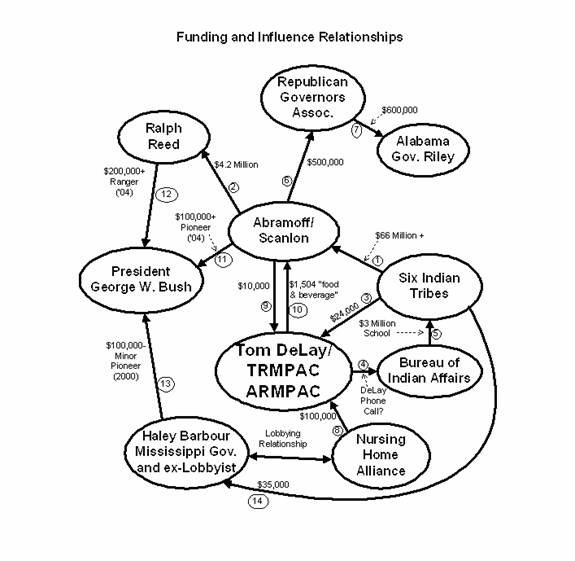 In the world of social network theory, much is made of the idea of "social capital" -- the notion that the network of social ties constitutes an important and productive form of wealth. This is a totally believable idea, but tends to mask the equally important truth that social networks can be used to do harm as well as good.
This is hardly a new idea -- if you watch any long-running police show like The Wire (best thing on television BTW) you will see the cops making social network graphs of criminal organizations, usually on a funky pinboard, and the better-equipped cops in real life have software to do the same thing. And the concept of netwar has been around for a long time, although apparently the lesson is just now penetrating the heads of our leaders, who, when faced with an distributed asymmetrical enemy, decide to invade a nation because that's what they know how to do.
So, that brings me to the inspiration for this post: the sudden outburst of cronyism, or more accurately, of awareness of cronyism. This started building with various Jack Abramoff-related news, peaked with Michael Brown, and is now climaxing as Tom Delay gets indicted, Bill Frist gets investigated, and other exciting news.
Cronyism is the soft form of criminal conspiracy, but it's also not that far removed from the groovier, more celebrated forms of social networking. The much-vaunted networks of Silicon Valley are a crucial form of capital, but they are also crony networks with the attendant downsides of insider deals and quid pro quos for the connected.
Oh hell, I have nothing original to say about this topic except that I coined a lovely phrase to describe what's going on here -- social crapital -- the tool by which the kakistocracy retains its death-like grip on the nation's mechanisms of power. Does not appear in Google so you heard it here first.
Hitchhiker's Guide to the Singularity
There is a nifty variant on wikis called TiddlyWiki that I hadn't seen before. Here, it's being used by singularity-obsessed SF writer Charlie Stross to organize his worldview in what he calls
Singularity! A Tough Guide to the Rapture of the Nerds
I am more impressed with the JavaScript than the content in this particular instance, but his SF is very definitely worth checking out. Living through the singularity doesn't have to be dreary.
Keywords: singularity, hypertext, writingsystems
Singularity! A Tough Guide to the Rapture of the Nerds
I am more impressed with the JavaScript than the content in this particular instance, but his SF is very definitely worth checking out. Living through the singularity doesn't have to be dreary.
Keywords: singularity, hypertext, writingsystems
Tuesday, September 27, 2005
Does God have something against oil rigs?

The weather gods are playing skittles with gulf oil rigs. Damn, there are a lot of those things sucking at the fossil fuel teat.
Thanks to Ken Restivo for the link.
Monday, September 26, 2005
Everything God Is Bad For You
RELIGIOUS belief can cause damage to a society, contributing towards high murder rates, abortion, sexual promiscuity and suicide, according to research published today.
...
“In general, higher rates of belief in and worship of a creator correlate with higher rates of homicide, juvenile and early adult mortality, STD infection rates, teen pregnancy and abortion in the prosperous democracies.
Wow, who'd've thunk?
Actually the thing that stands out from the original article is that the US is off the charts in both variables -- far more homicides and other social dysfunction than other first-world countries, combined with far more religiosity. American exceptionalism, indeed.


Subscribe to:
Posts (Atom)